Attention Residue: The Hidden Reason You Can't Focus After Switching Tasks
Research shows your brain stays cognitively attached to unfinished work long after you move on. This investigative review of Sophie Leroy's attention residue research explains why — and what the science actually recommends.
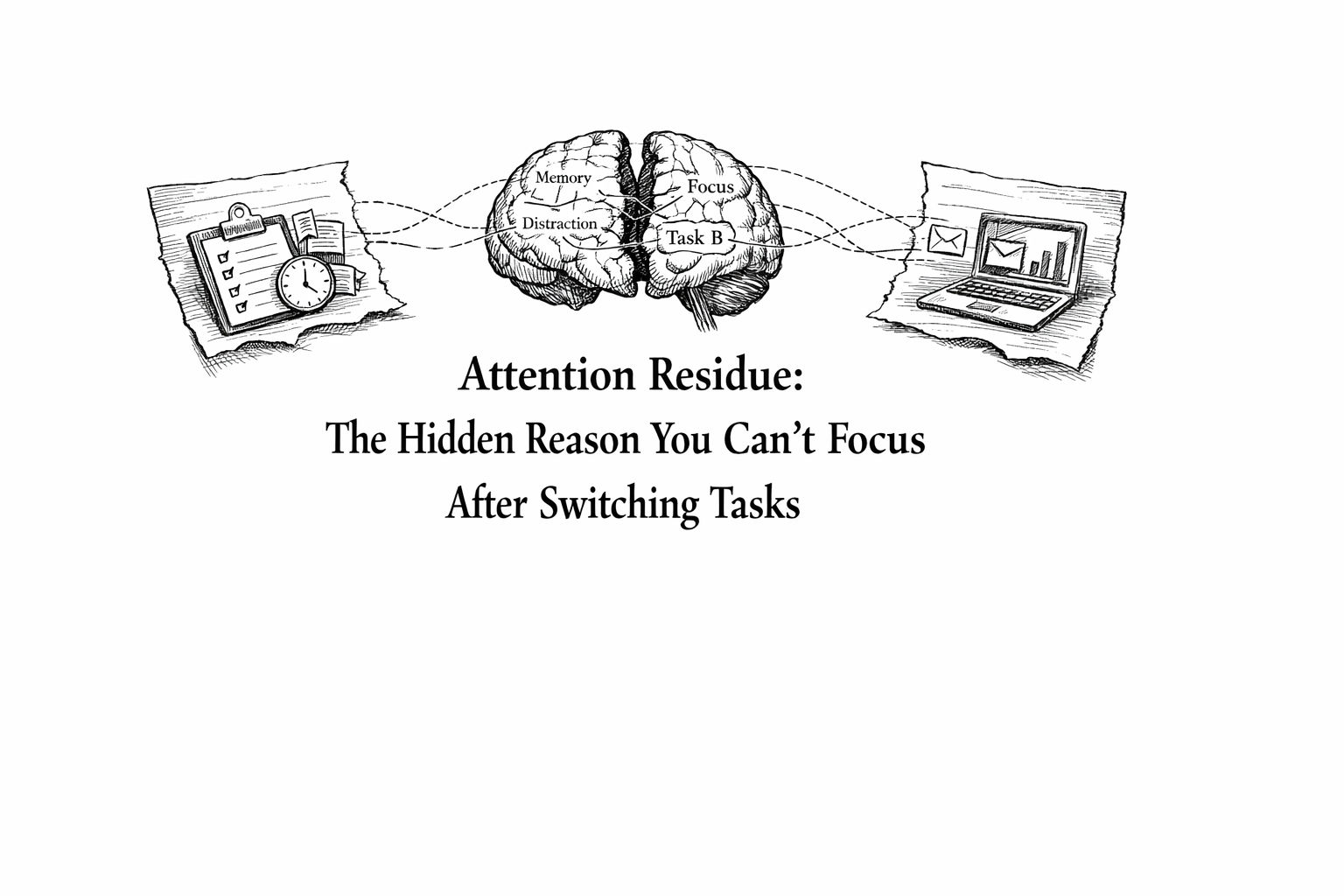
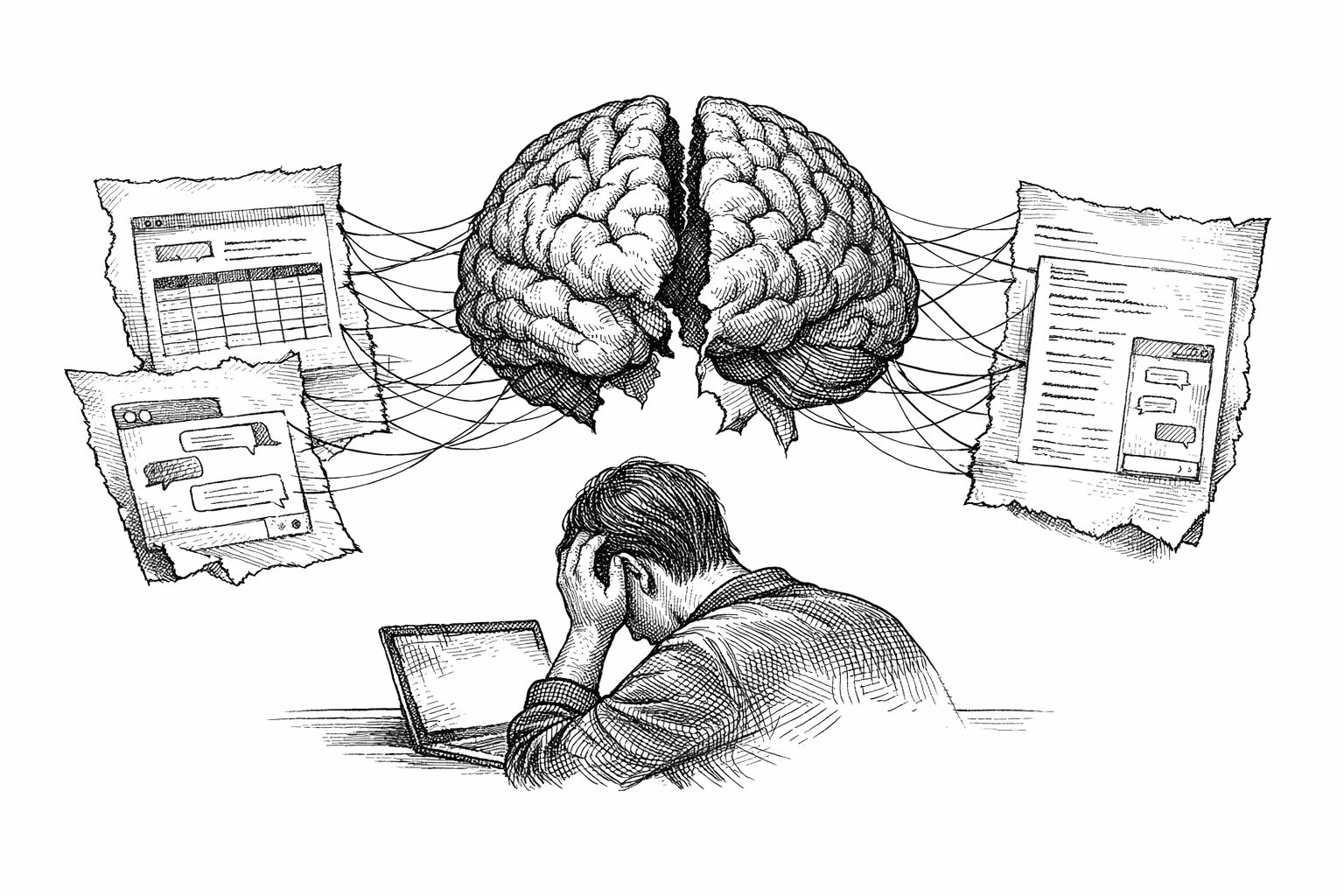
You close the spreadsheet. You open the code editor. You stare at the function you need to write, and for the next several minutes, your mind keeps drifting back to the budget numbers you were just reviewing. You’re not distracted by your phone, your inbox, or your environment. The distraction is inside your head.
This phenomenon has a name: attention residue. Coined by University of Washington researcher Sophie Leroy in 2009, it describes the cognitive residue that lingers when you transition from one task to another — particularly when the first task is unfinished. It is the scientific explanation for why context switching feels so costly, why deep work focus is so difficult to sustain, and why knowledge workers report feeling busy all day yet accomplishing remarkably little.
This is not a productivity hack article. What follows is an investigative review of the primary research, the corroborating evidence, and the structural implications for how modern knowledge work is organized.
The Original Experiment: What Leroy Actually Found
In 2009, Sophie Leroy — now Associate Professor of Management at the University of Washington Bothell — published a study that should have reshaped how every organization structures its workday. It largely didn’t. But the findings remain as relevant as ever.
Leroy’s experimental design was elegant. Participants were given Task A (typically a word puzzle or decision-making exercise) and then asked to switch to Task B. The critical variable was whether Task A was completed or interrupted before the transition. After switching, participants completed a lexical decision task — a standard cognitive test that measures whether concepts from the previous task are still active in working memory.
The results were unambiguous. Participants who switched away from an unfinished task showed significantly higher cognitive activation of Task A concepts while attempting Task B. Their performance on Task B suffered measurably. The residue wasn’t vague or metaphorical — it was detectable in reaction times and error rates.
Leroy’s conclusion was precise and damning for modern work culture:
People need to stop thinking about one task to fully transition their attention and perform well on another.
The mechanism underlying attention residue is rooted in the Zeigarnik effect — a well-established finding in cognitive psychology that the brain recalls incomplete tasks up to 90% better than completed ones. From an evolutionary standpoint, this makes sense: unfinished business requires continued monitoring. But in a modern workplace where you might switch between a dozen incomplete tasks before lunch, this adaptive mechanism becomes a liability. Each unfinished task creates an “open loop” that consumes working memory, and those loops don’t close just because you’ve opened a new browser tab. We’ve examined the Zeigarnik Effect in detail in The Zeigarnik Effect and Productivity — and the implications for how you should manage open loops in your daily work are more nuanced than the productivity advice implies.
This is the critical insight most productivity advice misses. Attention residue is cognitive, not environmental. Closing your tabs, silencing notifications, or moving to a quiet room does nothing to address the residue already loaded into working memory from the task you just abandoned.
The Time Pressure Paradox
Leroy's research revealed a counterintuitive finding about time pressure and attention residue. When participants completed a task under time pressure, residue was actually reduced — the urgency created a sense of closure. But when time pressure prevented completion, residue intensified. This is the fatal flaw of the modern workday: back-to-back meetings and artificial deadlines routinely force people to abandon tasks mid-stream, generating maximum cognitive residue at every transition.
Corroborating Evidence: The True Context Switching Cost
Leroy’s work doesn’t exist in isolation. A growing body of research confirms that task switching productivity losses are far greater than most organizations acknowledge.
Gloria Mark’s research at UC Irvine established that it takes 23 minutes and 15 seconds to fully refocus after an interruption (UC Irvine, 2024). This figure is frequently cited but rarely internalized. Consider its implications: a single Slack message doesn’t cost you the 30 seconds it takes to read and reply. It costs you 23 minutes of degraded cognitive performance afterward. A one-hour meeting in the middle of a coding session doesn’t cost one hour — it costs roughly three to four hours once you account for the ramp-down before the meeting and the recovery after.
This connects directly to Paul Graham’s famous distinction between the maker schedule and the manager schedule. Graham observed that a single meeting could destroy an entire afternoon for a programmer. The neuroscience of attention residue explains why: it’s not a personality quirk or a lack of discipline. It’s biology. The context switching cost for moving from deep technical work to a social, verbal meeting context — and back — is enormous because you’re not just switching tasks. You’re switching entire cognitive modes.
The aggregate numbers are staggering. According to a 2026 ByteIota analysis, developers face an average of 31.6 interruptions daily, with each interruption carrying the 23-minute recovery penalty. The estimated annual productivity loss: $50,000 per developer. Across the broader knowledge workforce, productivity studies estimate that workers lose 2.5 hours daily to context switching and attention residue — a figure that translates to roughly $450 billion annually for the US economy.
Why “Just Close Your Tabs” Misses the Point Entirely
The most common advice for how to focus better — minimize distractions, close unnecessary apps, use website blockers — addresses the triggers of task switching but not the residue it leaves behind. This is a fundamental category error.
Imagine you’re writing a technical specification. Halfway through, you’re pulled into a 30-minute meeting about a different project. After the meeting, you return to your document, close Slack, put on noise-cancelling headphones, and open only your text editor. Your environment is now optimized. But your working memory is still processing the decisions discussed in the meeting, the action items you need to follow up on, and the unresolved question your colleague raised. That cognitive load doesn’t vanish because your desktop is clean.
As Leroy herself explains:
The brain doesn't function where we want it to focus. Our brain likes to have things closed before switching.
This is the structural argument against multitasking — not that it’s merely inefficient, but that it may be cognitively impossible to fully recover from without deliberate disengagement. Every incomplete task leaves a trace in working memory. Stack enough traces and you’re not doing shallow work on multiple things — you’re doing degraded work on everything.
It’s also worth noting a nuance here: not all task switches are equal. Switching between similar cognitive modes — checking email, then responding to a Slack message — carries relatively low residue because you’re operating in the same mental register. The catastrophic switches are those that cross cognitive boundaries: moving from deep analytical work (coding, writing, financial modeling) to social-verbal work (meetings, calls, collaborative brainstorming), and back. Task batching works precisely because it keeps you within a single cognitive mode, minimizing the residue generated at each transition.
There is also a productive edge case. Cal Newport has noted that when you’re deeply immersed in a single project, the residue that persists during a brief walk or break can actually fuel subconscious problem-solving. The key distinction is single-project immersion versus multi-project switching. Beneficial residue comes from depth; destructive residue comes from fragmentation.
The Multitasking Myth, Quantified
Knowledge workers lose 2.5 hours daily to context switching and distractions (Productivity studies, 2026). Developers face 31.6 interruptions per day, each requiring ~23 minutes to recover from (ByteIota, 2026; UC Irvine, 2024). The annual cost per developer: $50,000 in lost productivity. This isn't a willpower problem. It's a structural one.
What the Research Actually Recommends
If attention residue is the problem, the solution isn’t superhuman concentration. It’s strategic disengagement — deliberate rituals that signal closure to your brain and externalize the open loops consuming your working memory.
The research converges on several evidence-based interventions:
1. Ready-to-Resume Plans
Before switching tasks, spend 2–3 minutes writing down exactly where you left off and what the next concrete step is. This directly addresses the Zeigarnik effect by externalizing the incomplete task from working memory to an external system. Studies in cognitive psychology show this technique reduces attention residue by 30–40% (Cognitive psychology studies, 2025). You’re not finishing the task — you’re giving your brain permission to release it.
2. Transition Rituals (5–10 Minutes)
Moria Smoski, Associate Professor at Duke Psychiatry and Behavioral Sciences, validates the neuroscience behind transition rituals:
A ritual signals 'OK, now it's done' — anything that brings attention to the transition is helpful.
Evidence-Based Transition Protocol
A research-backed sequence for switching tasks with minimal attention residue
Step 1
Write a Ready-to-Resume Plan
Before switching, write down exactly where you are and what the next concrete action is. This externalizes the open loop from working memory.
Step 2
Perform a Closure Ritual
Physically close the application, file, or notebook. Say or write 'done for now.' This signals cognitive disengagement to your brain.
Step 3
Take a Transition Break
Step away from your screen. Walk, stretch, or get water. Allow residue to dissipate before loading the next task context.
Step 4
Load the New Context Deliberately
Review your notes or plan for the next task before diving in. Prime your working memory with the new context intentionally.
3. Time Blocking as a Disengagement Mechanism
Time blocking isn’t just about scheduling — it’s a structural defense against attention residue. By dedicating 90-minute blocks to a single cognitive mode (deep work focus on one project, then a batch of communications, then another deep block), you minimize the number of high-cost cognitive transitions per day. The 2026 trend toward async communication and protected maker schedules reflects a growing organizational recognition that managing attention residue is not a personal productivity preference — it’s an economic imperative. For a practical guide to building schedules that actually withstand real-world pressure — meetings, deadlines, and the unexpected — see How to Build a Time-Blocked Schedule That Survives Contact With Reality. And for the biological dimension — why your timing of these blocks matters as much as the blocks themselves — Chronotype Research: Why Your Peak Productivity Hours Are Biologically Determined explains how to align deep work windows with your actual cognitive peaks.
4. Task Completion Signals in Your Tools
The tools you use should reinforce clean task boundaries. This is where structured task management becomes critical — not for organization’s sake, but for cognitive hygiene. When your system provides explicit completion signals and clear next-task entry points, it supports the disengagement-reengagement cycle that the research demands. Daybook’s structure, for instance, is designed around this principle: clean task boundaries, explicit completion states, and focused daily views that prevent the cognitive fragmentation of sprawling project boards.
The Structural Conclusion
The weight of evidence leads to a determination that challenges the prevailing consensus on multitasking. Attention residue research suggests that task switching isn’t just inefficient — it may be structurally impossible to recover from without deliberate disengagement rituals. The 23-minute recovery time isn’t a worst case; it’s the average. And in a workplace averaging 31.6 interruptions per day, the math is devastating.
The implications are organizational, not just personal. Every meeting without a buffer, every Slack culture that expects instant replies, every open-plan office that treats interruptions as collaboration — these are systems designed to maximize attention residue. The shift toward time blocking, async communication, and protected deep work schedules in 2026 isn’t a trend. It’s a correction, driven by the economic reality that $450 billion in annual productivity losses can no longer be ignored.
The research is clear. Your inability to focus after switching tasks isn’t a character flaw. It’s a predictable, measurable, neurological consequence of how your brain processes incomplete work. The solution isn’t to try harder. It’s to switch less — and when you must switch, to do it deliberately.
Key Takeaway
Attention residue is not a willpower problem — it's a design problem. Ready-to-resume plans, transition breaks, and time blocking reduce residue by 30–40%. The highest-leverage change you can make isn't a new app or a new habit. It's protecting uninterrupted blocks and building deliberate transitions between them.
Build Your Day Around Clean Task Boundaries
Daybook is designed to reduce attention residue by giving you focused daily views, explicit task completion signals, and structured transitions between work blocks. No sprawling boards. No infinite backlogs. Just today's work, clearly bounded.