Implementation Intentions: The Specific Planning Strategy That Turns Goals Into Follow-Through
Implementation intentions — 'if-then' plans backed by 94 studies and 30 years of research — are one of the most effective strategies for closing the gap between what you intend to do and what you actually do. Here's the science and how to apply it.
Sleep and Cognitive Performance: What the Neuroscience Says You're Actually Sacrificing
You've optimized your calendar, your focus blocks, and your task system. But the sleep productivity research is clear: if you're sleeping six hours a night, none of it is working as well as you think.
The Four-Day Work Week and Productivity: What the Research from Iceland, Microsoft Japan, and 4 Day Week Global Actually Shows
The four-day work week is everywhere in the news — but the actual research is more nuanced than the headlines. Here's what the Iceland trials, Microsoft Japan's experiment, and 4 Day Week Global's pilots really measured, where their methods fall short, and what you can apply right now.
The Pomodoro Technique at 35 Years: What the Research Says About Interval Work and Whether It Actually Holds Up
The Pomodoro Technique's 25-minute interval was never derived from a lab study. Here's what the actual cognitive science says about structured work-rest cycling — and a practical framework for choosing the right interval length for your work.
Attention Management vs. Time Management: Why Managing Hours Doesn't Fix a Focus Problem
Time management optimizes the wrong variable. Research from Herbert Simon to Gloria Mark shows that attention — not hours — is the scarce resource in knowledge work. Here's the evidence and a practical framework for managing what actually matters.
AI as a Daily Planning Tool: What the Research on Cognitive Offloading Says About Thinking With Machines
AI productivity tools are everywhere — but is using AI for daily planning evidence-backed or just hype? Here's what cognitive offloading research, the Extended Mind Thesis, and the latest adoption data actually say.
Ultradian Rhythms and the 90-Minute Work Cycle: What the Research Actually Shows
The '90-minute focus block' is everywhere — but most advice cites it without explaining the actual science. This post goes to Kleitman, Lavie, and Rossi's primary research and tells you what it actually shows, where it's solid, and where the popular version oversimplifies.
Timeboxing vs. Time Blocking: They're Not the Same Thing — and the Difference Matters
Most productivity content treats timeboxing and time blocking as synonyms. They're not. One protects your attention, the other constrains your effort — and they operate on entirely different psychological mechanisms. Here's the precise distinction and when to use each.
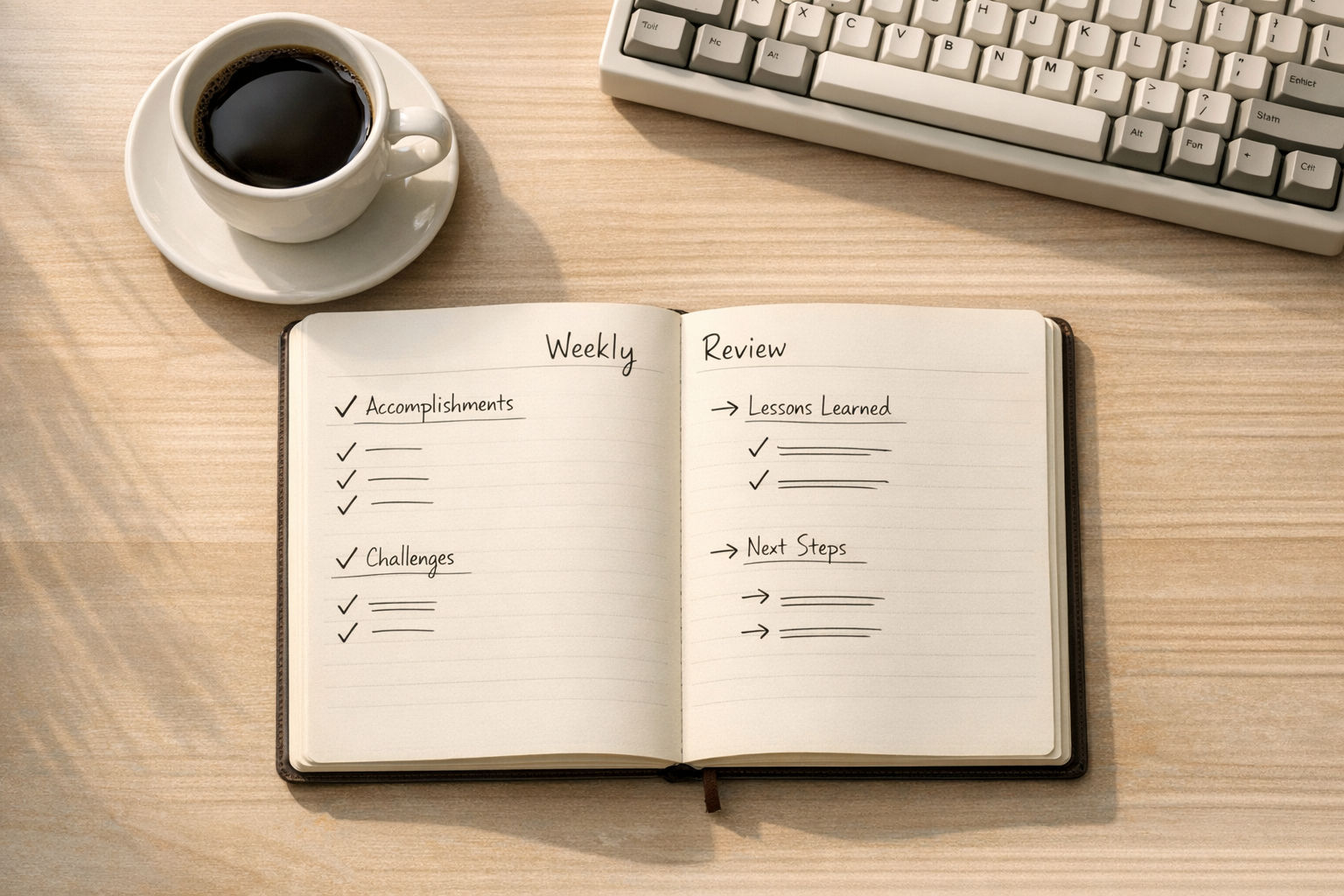
The Weekly Review: What GTD Gets Right, What the Research Adds, and How to Build One That Actually Sticks
The weekly review is GTD's most important step — and its most skipped. Here's the cognitive science that explains why it works, what David Allen's version gets right, and a lean 30-minute structure grounded in the evidence.
The Science of Procrastination: What Research Actually Reveals About Why We Delay (and What Works)
Procrastination research consistently shows it's an emotion regulation failure, not a time management problem. Here's what Temporal Motivation Theory, self-compassion studies, and 88 meta-analyzed papers actually say — and three evidence-based strategies that work.
Decision Fatigue Is Real: The Baumeister Research, Its Limits, and What Knowledge Workers Should Actually Do
Ego depletion was one of psychology's biggest ideas — until it failed to replicate. Here's an honest look at the decision fatigue research, what the 2016 replication crisis revealed, what actually holds up, and the defensible principles knowledge workers can apply today.
OKRs for Individual Contributors: What the Research Says About Personal Goal Frameworks That Actually Work
OKRs were built for organizations — but the psychology underneath maps to three separate research findings about individual goal attainment. Here's how to strip the corporate layer and build a personal OKR system grounded in what the science supports.
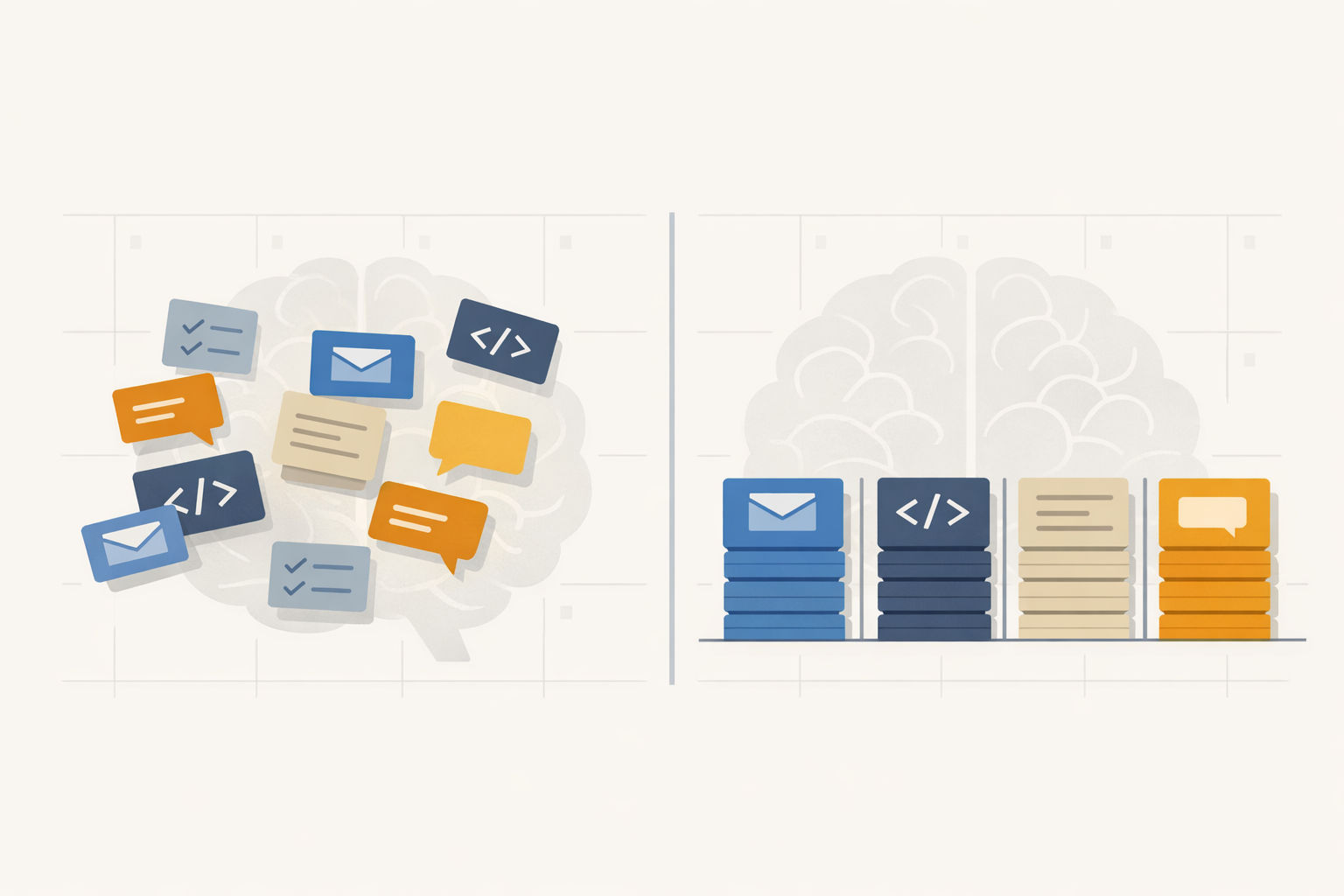
Task Batching: The Research-Backed Case for Grouping Similar Work (and How to Build the Habit)
Task batching isn't a productivity hack — it's applied cognitive science. Here's what the research on attention residue, switching costs, and cognitive load actually says about grouping similar work, and a concrete framework for building the habit.
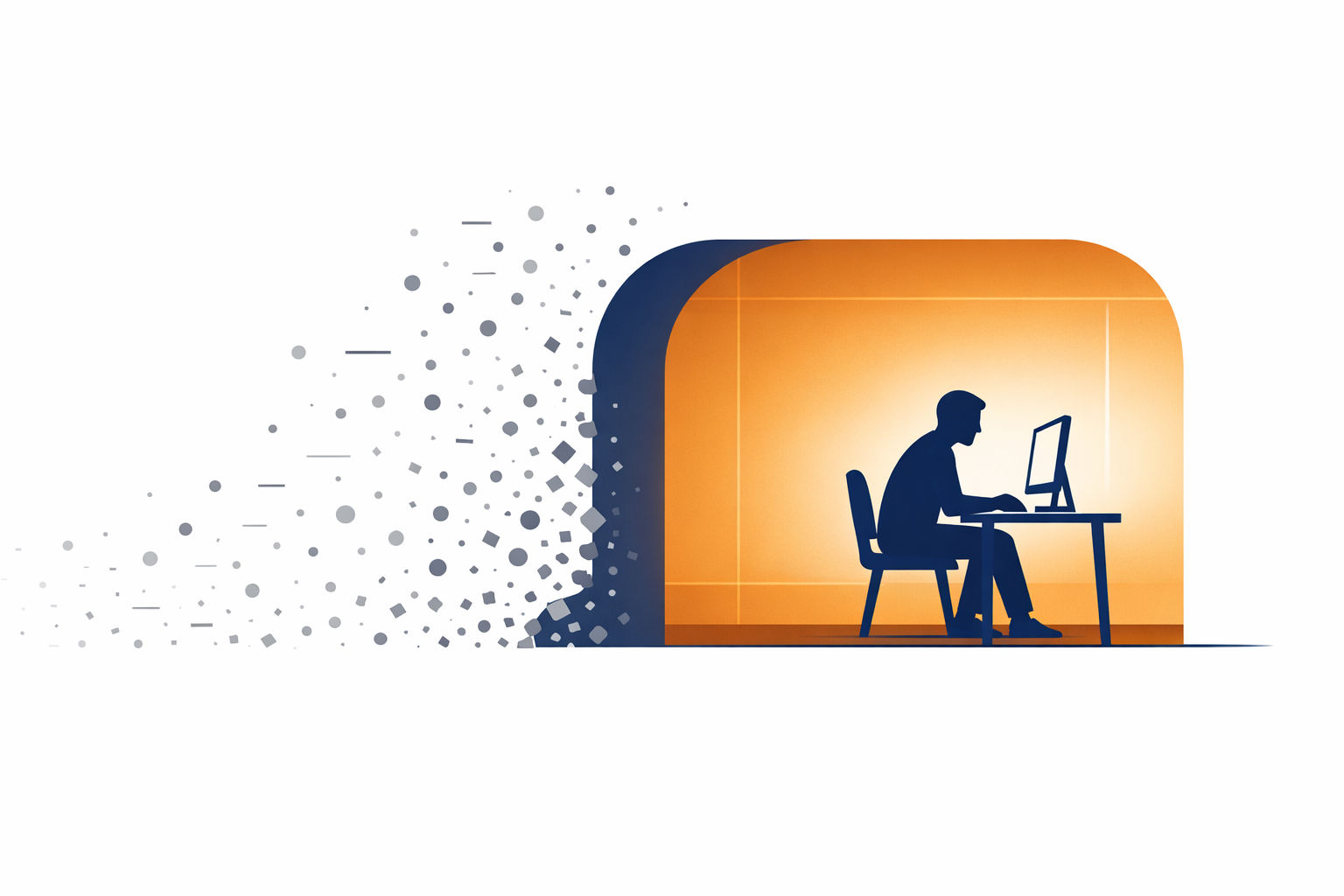
Flow State at Work: What Csikszentmihalyi's Research Actually Says (and How to Get There Reliably)
The pop-psychology version of 'flow' distorts what the research actually found. Here's what Csikszentmihalyi measured, what happens neurologically during flow, the four preconditions that reliably produce it — and why 3-4 hours a day is your ceiling.
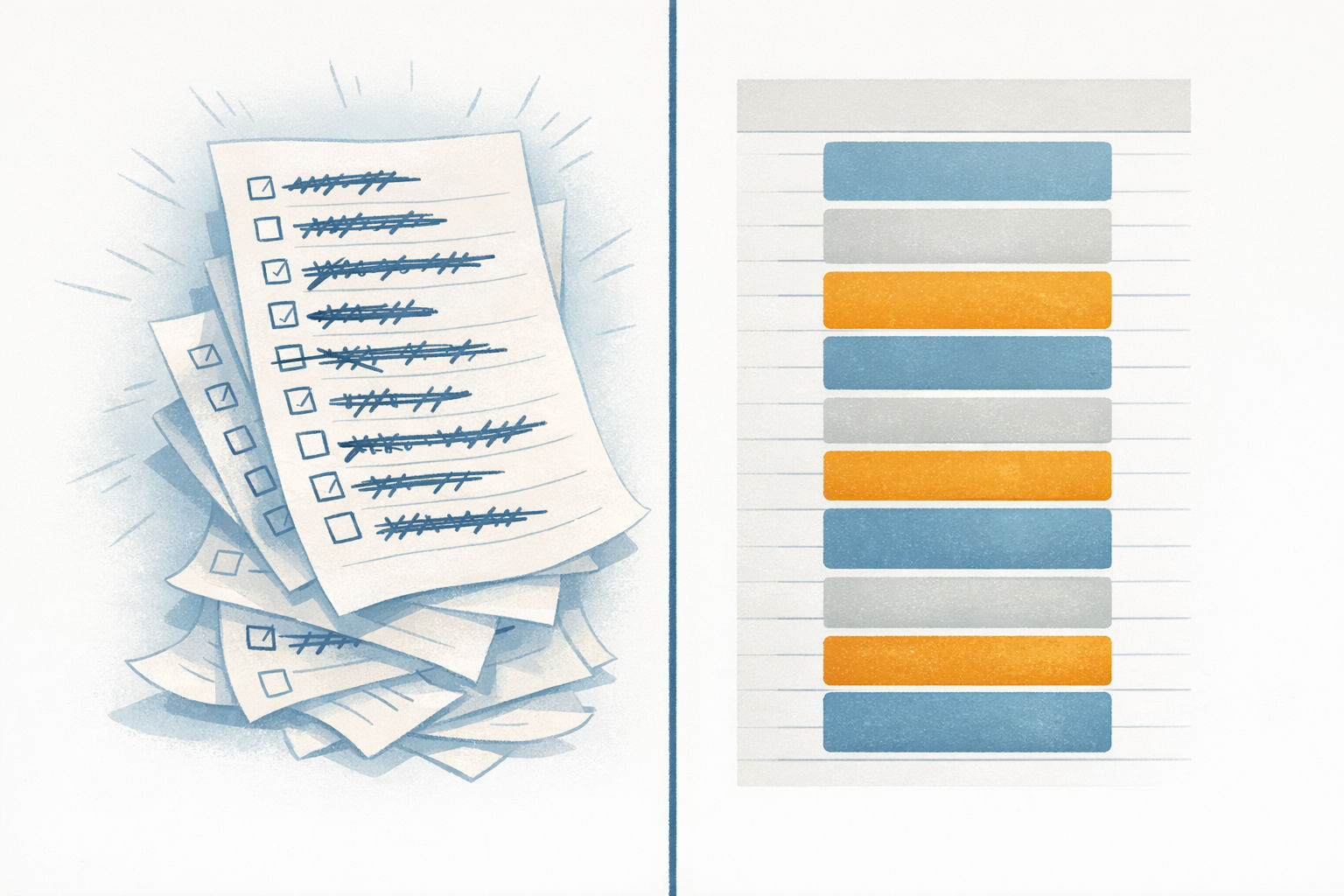
Time Blocking vs. Task Lists: What the Research Actually Says About Which System Wins
No randomised trial has directly compared time blocking to task lists. But four lines of cognitive science research — implementation intentions, the Zeigarnik effect, attention residue, and the planning fallacy — converge on the same conclusion. Here's what the evidence says, what it doesn't, and how to build a system that uses both.
Binaural Beats for Focus: What the Neuroscience Research Actually Shows
The research on binaural beats and productivity is more nuanced than the hype suggests. A systematic review of 14 studies found only 5 supporting brainwave entrainment. Here's what the evidence actually says — and what works better.
Meeting Overload for Knowledge Workers: What the Research Says About Calendar Fragmentation, Deep Work, and How to Design a Schedule That Protects Cognitive Output
Knowledge workers now spend 40-60% of their time in meetings — and the cognitive damage goes far beyond lost hours. Here's what the research actually says about meeting overload, attention residue, and how to architect a calendar that protects deep work.
AI Productivity Tools for Knowledge Workers: What the Research Actually Shows About Output Gains (vs. the Hype)
Controlled studies promise 25-55% productivity gains from AI tools, but 90% of real deployments see no measurable results. Here's what the research actually says about AI productivity for developers, consultants, and founders — and why the gap between lab and reality is organizational, not technical. To understand why AI-assisted work still demands deep, focused effort, see [Deep Work Neuroscience: What Actually Happens in Your Brain During Focused Effort](/blog/deep-work-neuroscience-what-actually-happens-in-your-brain-during-focused-effort-1773748907494). The cognitive limits that determine whether AI tools actually help are explained in [Cognitive Load Theory and Productivity: Why Your Brain Has a Bandwidth Problem](/blog/cognitive-load-theory-and-productivity-why-your-brain-has-a-bandwidth-problem-1774170486484). And for why switching between AI tools and your own work creates its own hidden cost, [Attention Residue: The Hidden Cost of Task-Switching](/blog/attention-residue-the-hidden-cost-of-task-switching-that-science-says-is-destroying-your-output-1773565689354) explains the mechanism.
Deliberate Practice vs. Regular Practice: What Ericsson's Research Actually Shows About Skill Acquisition
Anders Ericsson's deliberate practice research tells a far more nuanced story than the '10,000 hours rule.' Here's what the science actually says about how to improve at anything — and why most professionals plateau despite years of experience. The neuroscience behind why deliberate practice works — myelin reinforcement, prefrontal cortex demand, and neurochemical state — is covered in [Deep Work Neuroscience: What Actually Happens in Your Brain During Focused Effort](/blog/deep-work-neuroscience-what-actually-happens-in-your-brain-during-focused-effort-1773748907494). For a real-world example of deliberate, constrained work producing extraordinary output, see [Charles Darwin's Daily Routine: How 4.5 Hours of Focused Work Produced 19 Books](/blog/charles-darwin-daily-routine-how-4-5-hours-of-focused-work-produced-19-books-and-changed-science-forever-1774688883527). And if you want to understand why working memory capacity is the bottleneck that deliberate practice is actually training, [Cognitive Load Theory and Productivity](/blog/cognitive-load-theory-and-productivity-why-your-brain-has-a-bandwidth-problem-1774170486484) explains the mechanism.
The Procrastination Paradox: Why We Procrastinate Has Nothing to Do With Time Management
Three decades of procrastination science confirm that why we procrastinate is an emotion regulation problem, not a planning failure. Here's what the research actually says — and what evidence-based strategies work for knowledge workers. The most effective structural antidote the research supports is if-then planning — covered in depth in [Implementation Intentions: How If-Then Planning Doubles Your Follow-Through Rate](/blog/implementation-intentions-how-if-then-planning-doubles-your-follow-through-rate-research-guide-1775063294261). The related claim that willpower depletion causes procrastination is addressed in [Willpower Science: What the Research Actually Says After the Ego Depletion Replication Crisis](/blog/willpower-science-what-the-research-actually-says-after-the-ego-depletion-replication-crisis-1774706953150). For why unfinished tasks generate the anxious pull that feeds procrastination loops, see [The Zeigarnik Effect and Productivity](/blog/the-zeigarnik-effect-and-productivity-why-unfinished-tasks-hijack-your-brain-and-what-the-evidence-actually-supports-1774426122522).
How to Schedule Tasks by Cognitive Load, Not Deadlines: A Research-Backed Cognitive Load Productivity Framework
The default scheduling method is deadline-first — and the research says it's cognitively backwards. Here's how to apply John Sweller's Cognitive Load Theory to knowledge work scheduling, match task complexity to your biological rhythms, and get 4 hours of real output instead of 8 hours of diminishing returns. The foundation for this framework is [Cognitive Load Theory and Productivity: Why Your Brain Has a Bandwidth Problem](/blog/cognitive-load-theory-and-productivity-why-your-brain-has-a-bandwidth-problem-1774170486484). Matching cognitive load to biological peaks requires understanding your chronotype — see [Chronotype Research: Why Your Peak Productivity Hours Are Biologically Determined](/blog/chronotype-research-why-your-peak-productivity-hours-are-biologically-determined-and-what-to-do-about-it-1773824893013). And the 90-minute work cycle that structures most cognitive load scheduling is examined in [Ultradian Rhythms and the 90-Minute Work Cycle: What the Research Actually Says](/blog/ultradian-rhythms-and-the-90-minute-work-cycle-what-the-research-actually-says-1773842952653).
How to Regain Focus After Interruption: What Attention Research Actually Recommends
The real problem isn't the interruption — it's what happens in your brain afterward. Here's what cognitive science says about how to regain focus after interruption, why common advice fails, and the one research-backed technique most productivity writing ignores. This post builds directly on [Attention Residue: The Hidden Cost of Task-Switching](/blog/attention-residue-the-hidden-cost-of-task-switching-that-science-says-is-destroying-your-output-1773565689354) — the mechanism behind why focus recovery is so slow. The structural fix is covered in [How to Build a Time-Blocked Schedule That Survives Contact With Reality](/blog/how-to-build-a-time-blocked-schedule-that-survives-contact-with-reality-1773929369461), and the neurological side in [Deep Work Neuroscience: What Actually Happens in Your Brain During Focused Effort](/blog/deep-work-neuroscience-what-actually-happens-in-your-brain-during-focused-effort-1773748907494).
Implementation Intentions: How If-Then Planning Doubles Your Follow-Through Rate (Research Guide)
Only 28% of goals lead to action. Implementation intentions — specific if-then plans for when, where, and how you'll act — close the gap. Here's the evidence, the exact format, and where the method breaks down. This is the applied companion to [Goal Setting Science: Why SMART Goals Are Incomplete](/blog/goal-setting-science-why-smart-goals-are-incomplete-and-what-400-studies-actually-recommend-1774858077369). For the habit formation layer, see [Habit Stacking: Does Pairing New Behaviours With Existing Ones Actually Work?](/blog/habit-stacking-does-pairing-new-behaviours-with-existing-ones-actually-work-what-the-research-shows-1774188541531). The original treatment of this method is also covered in [Implementation Intentions: The Psychological Mechanism That Makes Plans Actually Work](/blog/implementation-intentions-the-psychological-mechanism-that-makes-plans-actually-work-1773583699294).
Chronotype Productivity Schedule: How to Design Your Workday Around Your Biology, Not Convention
The productivity world defaults to 'wake up at 5 AM.' Chronobiology research says that advice fails 80% of people. Here's a research-backed chronotype productivity schedule framework — with specific time-blocking templates for morning, intermediate, and evening types. The underlying science of chronotypes and biological prime time is covered in [Chronotype Research: Why Your Peak Productivity Hours Are Biologically Determined](/blog/chronotype-research-why-your-peak-productivity-hours-are-biologically-determined-and-what-to-do-about-it-1773824893013). For the 90-minute ultradian cycles that should structure each deep work block within your chronotype window, see [Ultradian Rhythms and the 90-Minute Work Cycle](/blog/ultradian-rhythms-and-the-90-minute-work-cycle-what-the-research-actually-says-1773842952653). To turn this biology-based schedule into a working daily plan, [How to Build a Time-Blocked Schedule That Survives Contact With Reality](/blog/how-to-build-a-time-blocked-schedule-that-survives-contact-with-reality-1773929369461) covers the implementation.
Single Tasking vs Multitasking: The Complete Research Picture Beyond 'Multitasking Is a Myth'
The standard take says multitasking is always bad. The actual neuroscience is more nuanced — and more useful. Here's what serial vs parallel processing in the brain really means for how you structure your workday. For the earlier, foundational treatment of why the brain cannot genuinely multitask, see [The Multitasking Myth: What Neuroscience Has Known for 20 Years That Productivity Culture Still Ignores](/blog/the-multitasking-myth-what-neuroscience-has-known-for-20-years-that-productivity-culture-still-ignores-1774274911258). The specific mechanism that makes task-switching so costly — attention residue — is examined in [Attention Residue: The Hidden Cost of Task-Switching](/blog/attention-residue-the-hidden-cost-of-task-switching-that-science-says-is-destroying-your-output-1773565689354). And to understand why working memory bandwidth is the binding constraint, read [Cognitive Load Theory and Productivity: Why Your Brain Has a Bandwidth Problem](/blog/cognitive-load-theory-and-productivity-why-your-brain-has-a-bandwidth-problem-1774170486484).
Cristiano Ronaldo's Sleep Routine Deconstructed: What Elite Athletic Science Actually Says About Cognitive Performance
We dissected every documented element of Cristiano Ronaldo's sleep routine — the five 90-minute cycles, Nick Littlehales' R90 method, the strategic naps — and held them against peer-reviewed sleep science. The results challenge the marketing narrative and reveal what knowledge workers can genuinely transfer. Ronaldo's five 90-minute sleep cycles map directly onto the ultradian biology examined in [Ultradian Rhythms and the 90-Minute Work Cycle: What the Research Actually Says](/blog/ultradian-rhythms-and-the-90-minute-work-cycle-what-the-research-actually-says-1773842952653). For a comparable elite routine analysis in a team-sport context, see [LeBron James's Daily Routine: What the NBA's Most Durable Athlete Reveals About Cognitive Performance Science](/blog/lebron-james-daily-routine-what-the-nba-s-most-durable-athlete-reveals-about-cognitive-performance-science-1774534096733). And for the neurological reason that quality sleep directly determines cognitive output, [Deep Work Neuroscience: What Actually Happens in Your Brain During Focused Effort](/blog/deep-work-neuroscience-what-actually-happens-in-your-brain-during-focused-effort-1773748907494) explains the mechanism.
4 Day Work Week Research: What the Iceland, Microsoft Japan, and Perpetual Guardian Trials Actually Found
We dissected the methodology, sample sizes, and measurement criteria behind every major 4-day work week trial. The data tells a more nuanced story than the headlines suggest — here's what it actually supports.
Carl Jung's Daily Routine: What the Father of Analytical Psychology's Schedule Reveals About Creative Output Science
Jung spent 26 weeks yearly in a primitive stone tower with no electricity, produced 20 volumes, and had 'the largest capacity for work' his colleagues had seen. We mapped his exact daily schedule against modern neuroscience to determine which habits are scientifically defensible — and which were personality quirks.
Goal Setting Science: Why SMART Goals Are Incomplete and What 400+ Studies Actually Recommend
SMART goals dominate corporate culture, but the framework lacks empirical foundation. Here's what Locke & Latham's 400+ studies, Gollwitzer's implementation intentions research, and modern goal setting science actually support — and what it means for knowledge workers. Related: Implementation Intentions Research and Habit Stacking Science.
Attention Span Research: What the Science Actually Says (The 8-Second Goldfish Stat Is Fabricated)
The viral claim that humans have an 8-second attention span — shorter than a goldfish — has no scientific basis. Here's what two decades of attention span research actually reveals about sustained focus, what truly degrades it, and how to reclaim it.
The Freelancer Productivity System: How to Create Structure When You Have None
Research shows freelancers are 68% more productive with flexibility — yet 41% report declining mental health from lack of structure. Here's the evidence-based framework for minimum viable structure that protects both your output and your sanity.
Willpower Science: What the Research Actually Says After the Ego Depletion Replication Crisis
The ego depletion model told us willpower was a depletable battery. Then a 2,141-person replication found essentially no effect. Here's what willpower science actually supports now — and what it means for structuring your workday. The original collapse of the ego depletion model is covered in detail in [Ego Depletion: Does Willpower Run Out? What 20 Years of Research Actually Shows](/blog/ego-depletion-does-willpower-run-out-what-20-years-of-research-actually-shows-1773997719101). For the downstream consequences on decision-making, see [Decision Fatigue: What the Research Actually Says](/blog/decision-fatigue-what-the-research-actually-says-and-what-most-productivity-advice-gets-wrong-1773738478965). And for why the popular belief that willpower failure causes procrastination is itself wrong, [The Procrastination Paradox: Why We Procrastinate Has Nothing to Do With Time Management](/blog/the-procrastination-paradox-why-we-procrastinate-has-nothing-to-do-with-time-management-1775293794906) explains what the evidence actually shows.
Charles Darwin Daily Routine: How 4.5 Hours of Focused Work Produced 19 Books and Changed Science Forever
Charles Darwin worked just 4.5 hours a day in three 90-minute blocks — and produced one of history's greatest scientific outputs. Here's his exact schedule, the neuroscience behind why it worked, and a framework you can apply today.
Motivation Science: Why 'Money Kills Motivation' Is Wrong — and What 128 Studies Actually Show
The popular narrative says extrinsic rewards destroy intrinsic motivation. Four decades of motivation science tell a more nuanced story. Here's what the data actually supports — and what it means for how knowledge workers should design their incentive systems.
Morning Routine Productivity Is a Myth for Most People: What Chronobiology Research Actually Says
The 5 AM Club assumes everyone's brain peaks at dawn. Chronobiology research says otherwise — 30% of the population are night owls by genetics, not laziness. Here's what the science actually supports about timing, routines, and peak performance.
LeBron James Daily Routine: What the NBA's Most Durable Athlete Reveals About Cognitive Performance Science
LeBron James spends $1.5M annually on recovery and reportedly sleeps 12 hours a day. We mapped every documented element of his daily routine to peer-reviewed research to answer one question: how much of your cognitive performance is determined by physical recovery?
Timeboxing vs Time Blocking: What the Research Actually Says About Which Method Produces Better Output
Most productivity advice treats timeboxing and time blocking as interchangeable. They're not. Here's the cognitive science behind each method, where they produce different outcomes, and a specific verdict on which one you should use.
Richard Feynman Productivity: How the Physicist's Daily Habits Reveal the Science of Accelerated Mastery
Feynman's Nobel Prize work emerged from play, not grind. We mapped his documented habits to modern learning science—retrieval practice, deliberate practice, the protégé effect—and made a determination: what's replicable by knowledge workers and what's survivorship bias.
The Zeigarnik Effect and Productivity: Why Unfinished Tasks Hijack Your Brain — and What the Evidence Actually Supports
The Zeigarnik Effect promises that unfinished tasks sharpen memory and drive productivity. But the original 1927 finding barely replicates. Here's what the science actually says about open loops, cognitive load, and the one intervention that works.
Environmental Design Productivity: How Your Workspace Is Making Thousands of Decisions for You Daily
Your physical and digital environment controls up to 40% of your productive output — not through motivation, but through invisible defaults, friction, and triggers. Here's the science of choice architecture for knowledge work, and a framework for redesigning both your desk and your desktop.
Inside Haruki Murakami's Daily Routine: What 45 Years of Running and Writing Reveal About Cognitive Performance
Haruki Murakami's daily routine of waking at 4 AM, writing for 5-6 hours, and running 10 kilometers has produced 14+ novels over 45 years. Here's what exercise neuroscience says about why it works — and which elements you can actually replicate.
The Multitasking Myth: What Neuroscience Has Known for 20 Years That Productivity Culture Still Ignores
Neuroscience proved multitasking was impossible in 2001. Twenty years later, knowledge workers still switch apps 1,200 times daily at a cost of $450 billion annually. Here's the evidence — and why we keep ignoring it.
The Elon Musk Schedule Deconstructed: What Science Actually Says About 5-Minute Time Blocking
Elon Musk schedules his entire day in 5-minute blocks. We applied neuroscience research on attention residue, task-switching costs, and cognitive load to stress-test his method — and reached a specific verdict on what's defensible and what's cargo cult.
Habit Stacking: Does Pairing New Behaviours With Existing Ones Actually Work? What the Research Shows
Habit stacking promises effortless behaviour change by linking new habits to existing routines. But what does the peer-reviewed evidence actually support? We examine the research — implementation intentions, cue-response learning, and the 21-day myth — to reach a specific, defensible conclusion.
Cognitive Load Theory and Productivity: Why Your Brain Has a Bandwidth Problem
Your working memory holds just 3-5 items, yet modern work demands hundreds of context switches daily. Here's what cognitive load theory reveals about why complex work feels so hard — and the highest-leverage interventions the science actually supports. If you want to see how cognitive load applies directly to scheduling, read [How to Schedule Tasks by Cognitive Load, Not Deadlines](/blog/how-to-schedule-tasks-by-cognitive-load-not-deadlines-a-research-backed-cognitive-load-productivity-framework-1775149750113). For the downstream effect of overloaded working memory, see [Attention Residue: The Hidden Cost of Task-Switching](/blog/attention-residue-the-hidden-cost-of-task-switching-that-science-says-is-destroying-your-output-1773565689354) and [The Multitasking Myth](/blog/the-multitasking-myth-what-neuroscience-has-known-for-20-years-that-productivity-culture-still-ignores-1774274911258).
The Developer's Deep Work Schedule: A Research-Backed Framework for Maximising Developer Productivity
Deep work produces 500% more value, yet developers average just 2-3 hours of focus daily. Here's a research-backed framework for structuring your coding schedule around cognitive science — not productivity myths.
Dopamine Productivity: What the Neuroscience Actually Says About Motivation and Reward
The popular 'dopamine hit' narrative is wrong. Here's what the actual neuroscience — prediction errors, wanting vs liking, the inverted-U curve — says about dopamine productivity and how to structure your work around it.
Warren Buffett's Daily Routine: What the World's Most Patient Investor Reveals About Cognitive Prioritisation
Warren Buffett spends 80% of his workday reading while most executives sit in 19+ hours of meetings weekly. The science behind his daily routine reveals a masterclass in cognitive load management — not time management.
Ego Depletion: Does Willpower Run Out? What 20 Years of Research Actually Shows
The ego depletion theory claimed willpower is a finite resource — backed by 600+ studies. Then a massive replication effort found almost nothing. Here's an investigative look at what the evidence actually shows and what it means for knowledge workers. The more recent picture of where willpower science has landed since the replication crisis is covered in [Willpower Science: What the Research Actually Says After the Ego Depletion Replication Crisis](/blog/willpower-science-what-the-research-actually-says-after-the-ego-depletion-replication-crisis-1774706953150). For the closely related question of whether making decisions depletes us, see [Decision Fatigue: What the Research Actually Says](/blog/decision-fatigue-what-the-research-actually-says-and-what-most-productivity-advice-gets-wrong-1773738478965). And since willpower failure is frequently — and incorrectly — blamed for procrastination, [The Procrastination Paradox: Why We Procrastinate Has Nothing to Do With Time Management](/blog/the-procrastination-paradox-why-we-procrastinate-has-nothing-to-do-with-time-management-1775293794906) explains what the evidence actually points to instead.
How to Build a Time-Blocked Schedule That Survives Contact With Reality
Most time blocking for productivity fails not because the method is wrong, but because it ignores what research says about planning fallacy, interruption recovery, and cognitive switching. Here's a research-backed time blocking schedule that actually holds up. For the biological layer — when to schedule which type of work — see [Chronotype Research: Why Your Peak Productivity Hours Are Biologically Determined](/blog/chronotype-research-why-your-peak-productivity-hours-are-biologically-determined-and-what-to-do-about-it-1773824893013) and [Ultradian Rhythms and the 90-Minute Work Cycle](/blog/ultradian-rhythms-and-the-90-minute-work-cycle-what-the-research-actually-says-1773842952653). For the comparison between methods, see [Timeboxing vs Time Blocking: What the Research Actually Says](/blog/timeboxing-vs-time-blocking-what-the-research-actually-says-about-which-method-produces-better-output-1774512559093).
Ultradian Rhythms and the 90-Minute Work Cycle: What the Research Actually Says
The 90-minute ultradian rhythm has become productivity gospel. But Kleitman's original research was about sleep, not spreadsheets. Here's what the evidence actually supports — and what it doesn't — about structuring deep work around biological cycles. Related: Chronotype Research and the Developer Deep Work Schedule.
Chronotype Research: Why Your Peak Productivity Hours Are Biologically Determined (And What To Do About It)
Your chronotype — not your discipline — determines when your brain performs best. Here's what the research actually shows about biological prime time, cognitive performance peaks, and how to build a schedule around your biology. Related: Ultradian Rhythms and the 90-Minute Work Cycle, Morning Routine Productivity Research, and Time Blocking for Productivity.
Stephen King's Writing Routine: What a 2,000-Words-a-Day Habit Reveals About Consistency Science
Stephen King has written 2,000 words every morning for 50 years, producing 65+ novels and 400 million copies sold. But the real story isn't discipline — it's what habit formation science, chronobiology, and deliberate practice research reveal about why his specific structure works, and where it breaks down.
Deep Work Neuroscience: What Actually Happens in Your Brain During Focused Effort
The brain during deep work isn't just 'more focused' — it's in a categorically different neurochemical state. Here's the actual biology: prefrontal cortex metabolism, myelin reinforcement, dopamine dynamics, and why 'focus harder' is the wrong advice. Related: Attention Residue, Cognitive Load Theory, and The Developer's Deep Work Schedule.
Decision Fatigue: What the Research Actually Says (And What Most Productivity Advice Gets Wrong)
The science behind decision fatigue is far messier than most productivity articles admit. Here's what the evidence actually shows — including the replication crisis that upended the original theory — and what it means for how you structure your workday. The ego depletion model that decision fatigue theory depends on is examined closely in [Ego Depletion: Does Willpower Run Out? What 20 Years of Research Actually Shows](/blog/ego-depletion-does-willpower-run-out-what-20-years-of-research-actually-shows-1773997719101). For what self-control science actually supports after the replications failed, see [Willpower Science: What the Research Actually Says After the Ego Depletion Replication Crisis](/blog/willpower-science-what-the-research-actually-says-after-the-ego-depletion-replication-crisis-1774706953150). And if you want to apply this to your actual schedule, [How to Schedule Tasks by Cognitive Load, Not Deadlines](/blog/how-to-schedule-tasks-by-cognitive-load-not-deadlines-a-research-backed-cognitive-load-productivity-framework-1775149750113) offers a research-backed framework for matching task demand to mental bandwidth.
What Charles Darwin's Daily Routine Reveals About the Science of Sustainable Deep Work
Charles Darwin worked just 4.5 hours a day and produced 19 books including Origin of Species. Modern neuroscience explains why his schedule wasn't a limitation — it was an optimized cognitive system that most knowledge workers should steal.
Implementation Intentions: The Psychological Mechanism That Makes Plans Actually Work
Most goal-setting advice is built on the wrong model of human behaviour. Peter Gollwitzer's implementation intentions research reveals why if-then planning nearly triples success rates for difficult goals — and why your to-do list keeps failing you. Related: Goal Setting Science and Habit Stacking Research.
Attention Residue: The Hidden Cost of Task-Switching That Science Says Is Destroying Your Output
Research shows attention residue from task-switching costs knowledge workers 4+ hours per week and up to 40% of their cognitive capacity. Here's the neuroscience behind why — and three structural interventions that actually fix it. The root cause is explained in [Cognitive Load Theory and Productivity: Why Your Brain Has a Bandwidth Problem](/blog/cognitive-load-theory-and-productivity-why-your-brain-has-a-bandwidth-problem-1774170486484). For the recovery side — what to do after an interruption has already hit — see [How to Regain Focus After Interruption](/blog/how-to-regain-focus-after-interruption-what-attention-research-actually-recommends-1775120913302). The structural fix is [The Multitasking Myth](/blog/the-multitasking-myth-what-neuroscience-has-known-for-20-years-that-productivity-culture-still-ignores-1774274911258).
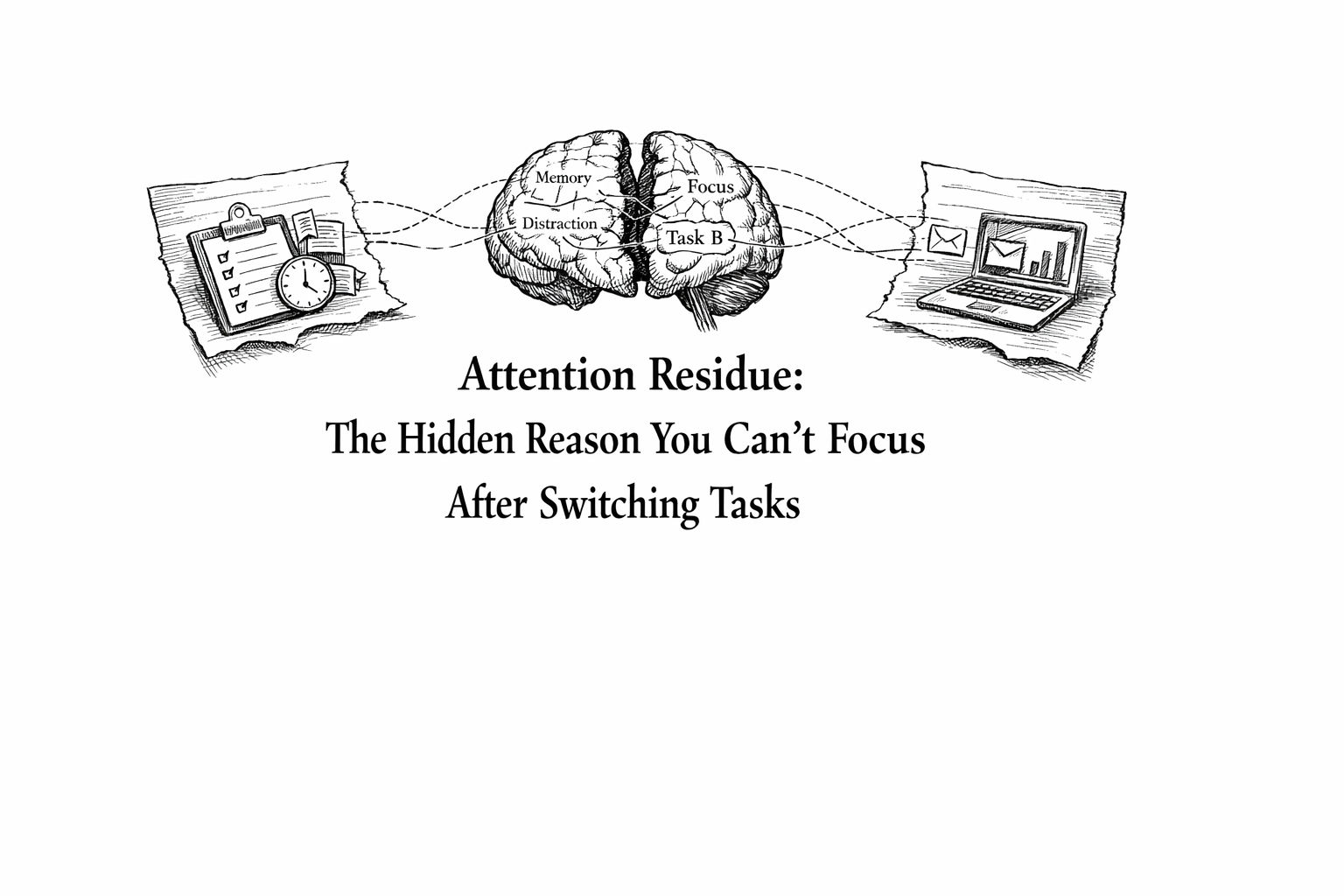
Attention Residue: The Hidden Reason You Can't Focus After Switching Tasks
Research shows your brain stays cognitively attached to unfinished work long after you move on. This investigative review of Sophie Leroy's attention residue research explains why — and what the science actually recommends.