Binaural beats playlists have billions of streams on Spotify and YouTube. The pitch is seductive: put on headphones, play a specific frequency, and your brain shifts into a focused state. No effort, no discipline — just sound.
If you’re a developer or knowledge worker who’s tried this during a coding session, you’re not alone. But the question worth asking is whether binaural beats productivity claims hold up when you look at the actual research — not testimonials, not marketing, but controlled studies with real measurement.
The answer is: it’s complicated. Not debunked, but far less proven than the YouTube thumbnail suggests.
How Binaural Beats Work (The Auditory Illusion)
Binaural beats are an auditory illusion. When you hear a 400 Hz tone in your left ear and a 410 Hz tone in your right ear, your brain perceives a third tone pulsing at 10 Hz — the difference between the two frequencies. This phantom beat doesn’t exist in the air. Your auditory cortex creates it.
The theoretical basis is called the frequency following response (FFR): the idea that your brain’s electrical activity tends to synchronize with external rhythmic stimuli. Play a 14 Hz binaural beat and, in theory, your brain shifts toward 14 Hz beta wave activity — the range associated with alertness and concentration.
The relevant frequency bands for binaural beats focus science:
- Beta waves (14–30 Hz): Associated with active thinking, alertness, and focused concentration
- Alpha waves (8–14 Hz): Associated with relaxed attention and creative thinking
- Gamma waves (30–100 Hz): Associated with higher-order cognitive processing
- Theta waves (4–8 Hz): Associated with drowsiness and meditation
The claim is straightforward: expose your brain to a beat at the “right” frequency, and it follows along. Beta waves for focus. Alpha for relaxed creativity. The mechanism sounds plausible. But does it actually happen?
What the Studies Actually Show
The binaural beats concentration research spans about three decades. There are genuine positive signals — and significant problems.
The Positive Signals
Lane et al. (1998) ran one of the earliest controlled tests. Twenty-nine participants performed a 30-minute vigilance monitoring task while listening to beta-frequency binaural beats (16 and 24 Hz) versus theta/delta beats (1.5 and 4 Hz). Beta beats produced significantly more correct target detections and fewer false alarms (t(28) = 2.26, p < 0.02). Participants also reported less fatigue and better subjective alertness.
Colzato et al. (2015) at Leiden University found that 40 Hz gamma binaural beats narrowed the attentional spotlight — participants showed a significantly reduced global-precedence effect compared to controls (F(1,34) = 31.70, p < .0001, η²_p = 0.48). That’s a large effect size for a cognitive task.
A 2022 meta-analysis in Psychological Research (Banerjee et al.) pooled 15 studies and 31 effect sizes. The result: a medium, statistically significant overall effect (Hedges’ g = 0.40) for binaural beats on memory and attention. That’s not nothing.
A 2025 study in Scientific Reports (Nature) confirmed via EEG that brain entrainment does occur — gamma-frequency beats with a low carrier tone and white noise background improved general attention performance in an 80-participant crossover design.
What Does an Effect Size of g = 0.40 Mean?
A Hedges' g of 0.40 is a "medium" effect in psychology — roughly meaning the average person in the binaural beats group performed better than about 66% of the control group. For comparison, the effect of homework on academic achievement is about g = 0.29, and the effect of psychotherapy on depression is about g = 0.68. So 0.40 isn't trivial — but it's not transformative either, especially given the caveats below.
The Significant Caveats
Before you invest in a binaural beats subscription, the problems with this evidence are substantial.
The brainwave entrainment hypothesis is weakly supported. A 2023 systematic review by Ingendoh et al. in PLoS ONE — the most comprehensive to date — examined 14 studies specifically testing whether binaural beats actually change brain oscillatory activity as measured by EEG. The results: only 5 studies supported the entrainment hypothesis, 8 contradicted it, and 1 was mixed. The authors noted extreme methodological heterogeneity across studies.
This is the core problem. Even if binaural beats improve task performance in some studies, the proposed mechanism — that they do so by entraining brainwaves — is not reliably demonstrated. Something may be happening, but it may not be what proponents claim.
Sample sizes are small. Lane’s 1998 study had 29 participants. Colzato’s had 36. The 2025 Scientific Reports study had 80, which is better, but still modest for drawing strong conclusions about a cognitive intervention. Small samples inflate effect sizes and reduce replicability.
The placebo confound is real. A 2020 study found that binaural beats synchronized brain activity no more effectively than monaural beats (where the two tones are mixed before reaching your ears — no auditory illusion involved). Neither condition affected mood. This suggests the effects people report may come from the ritual of putting on headphones and committing to focus — not from the specific auditory phenomenon.
A 1,000-participant RCT found binaural beats worsened performance on complex learning tasks compared to music or noise alone. The researchers suggested binaural beats might interfere with the variable brainwave activity that complex cognition requires.
Key binaural beats research findings — the evidence runs in both directions
| Study | N | Finding | Direction |
|---|
| Lane et al. (1998) | 29 | Beta BB improved vigilance hits, reduced false alarms vs. theta/delta | Positive |
| Colzato et al. (2015) | 36 | 40 Hz gamma BB narrowed attentional spotlight (η²_p = 0.48) | Positive |
| Banerjee et al. (2022) meta-analysis | 15 studies | Medium effect size on attention and memory (g = 0.40) | Positive |
| Ingendoh et al. (2023) systematic review | 14 studies | 5 supported entrainment, 8 contradicted, 1 mixed | Mixed/Negative |
| Nature Scientific Reports (2025) | 80 | EEG entrainment confirmed; general attention improved, sustained attention did not | Mixed |
| 1,000-participant RCT (2023) | 1,000 | BB worsened complex learning task performance vs. music or noise | Negative |
The Broader “Sound and Focus” Evidence
To understand whether binaural beats deserve a spot in your focus toolkit, it helps to look at the broader research on sound and cognitive performance.
Moderate ambient noise has better evidence. Ravi Mehta at the University of Illinois published a widely cited 2012 study in the Journal of Consumer Research showing that moderate ambient noise (~70 dB, roughly coffee-shop level) enhanced creative performance compared to both quiet (~50 dB) and loud (~85 dB) conditions. The mechanism: mild distraction induces processing disfluency, which promotes abstract thinking. Five experiments, consistent results, clear inverted-U relationship.
The “Mozart effect” is a cautionary tale. In 1993, Rauscher et al. claimed that listening to Mozart temporarily boosted spatial reasoning. Media ran with it. States funded classical music programs for infants. Then Steele et al. (1999) tried to replicate it and found nothing — no effect on spatial reasoning whatsoever. Later meta-analyses confirmed the original finding was inflated, not unique to Mozart, and likely driven by mood/arousal rather than any special property of the music. If you’ve been in this field long enough, you’ve seen this pattern before: intriguing initial finding → media amplification → failed replications → modest-at-best reality.
Binaural beats aren’t the Mozart effect. There’s more research, and some of it is genuinely rigorous. But the pattern of early hype outrunning the evidence is familiar.
What does have robust evidence is the effect of silence from interruption. Gloria Mark’s research at UC Irvine found that knowledge workers who self-initiated their email checks (rather than responding to notifications) rated their productivity significantly higher during longer work sessions. The mechanism isn’t auditory — it’s structural. Removing the decision to check frees cognitive resources for the task at hand. This connects directly to what we know about attention residue and the hidden cost of task-switching — and it’s the same principle behind why meeting overload destroys deep work capacity more than any auditory environment could fix.
For knowledge workers dealing with fragmented calendars, the research on how to regain focus after interruption makes a complementary point: the structural conditions under which you work — not the sounds you pipe through your headphones — determine whether genuine focus recovery is even possible. And the single tasking vs. multitasking research makes the same case from a different angle: it’s whether your switches are reactive or controlled, not what’s playing in your headphones, that determines cognitive cost.
The evidence base for structural focus strategies — time blocking, notification management, deep work scheduling — is substantially stronger than for auditory interventions.
The Broader “Sound and Focus” Evidence
To understand whether binaural beats deserve a spot in your focus toolkit, it helps to look at the broader research on sound and cognitive performance.
Moderate ambient noise has better evidence. Ravi Mehta at the University of Illinois published a widely cited 2012 study in the Journal of Consumer Research showing that moderate ambient noise (~70 dB, roughly coffee-shop level) enhanced creative performance compared to both quiet (~50 dB) and loud (~85 dB) conditions. The mechanism: mild distraction induces processing disfluency, which promotes abstract thinking. Five experiments, consistent results, clear inverted-U relationship.
The “Mozart effect” is a cautionary tale. In 1993, Rauscher et al. claimed that listening to Mozart temporarily boosted spatial reasoning. Media ran with it. States funded classical music programs for infants. Then Steele et al. (1999) tried to replicate it and found nothing — no effect on spatial reasoning whatsoever. Later meta-analyses confirmed the original finding was inflated, not unique to Mozart, and likely driven by mood/arousal rather than any special property of the music. If you’ve been in this field long enough, you’ve seen this pattern before: intriguing initial finding → media amplification → failed replications → modest-at-best reality.
Binaural beats aren’t the Mozart effect. There’s more research, and some of it is genuinely rigorous. But the pattern of early hype outrunning the evidence is familiar.
What does have robust evidence is the effect of silence from interruption. Gloria Mark’s research at UC Irvine found that knowledge workers who self-initiated their email checks (rather than responding to notifications) rated their productivity significantly higher during longer work sessions. The mechanism isn’t auditory — it’s structural. Removing the decision to check frees cognitive resources for the task at hand. This connects directly to what we know about attention residue and the hidden cost of task-switching — and it’s the same principle behind why meeting overload destroys deep work capacity more than any auditory environment could fix.
What Has Stronger Evidence Than Binaural Beats
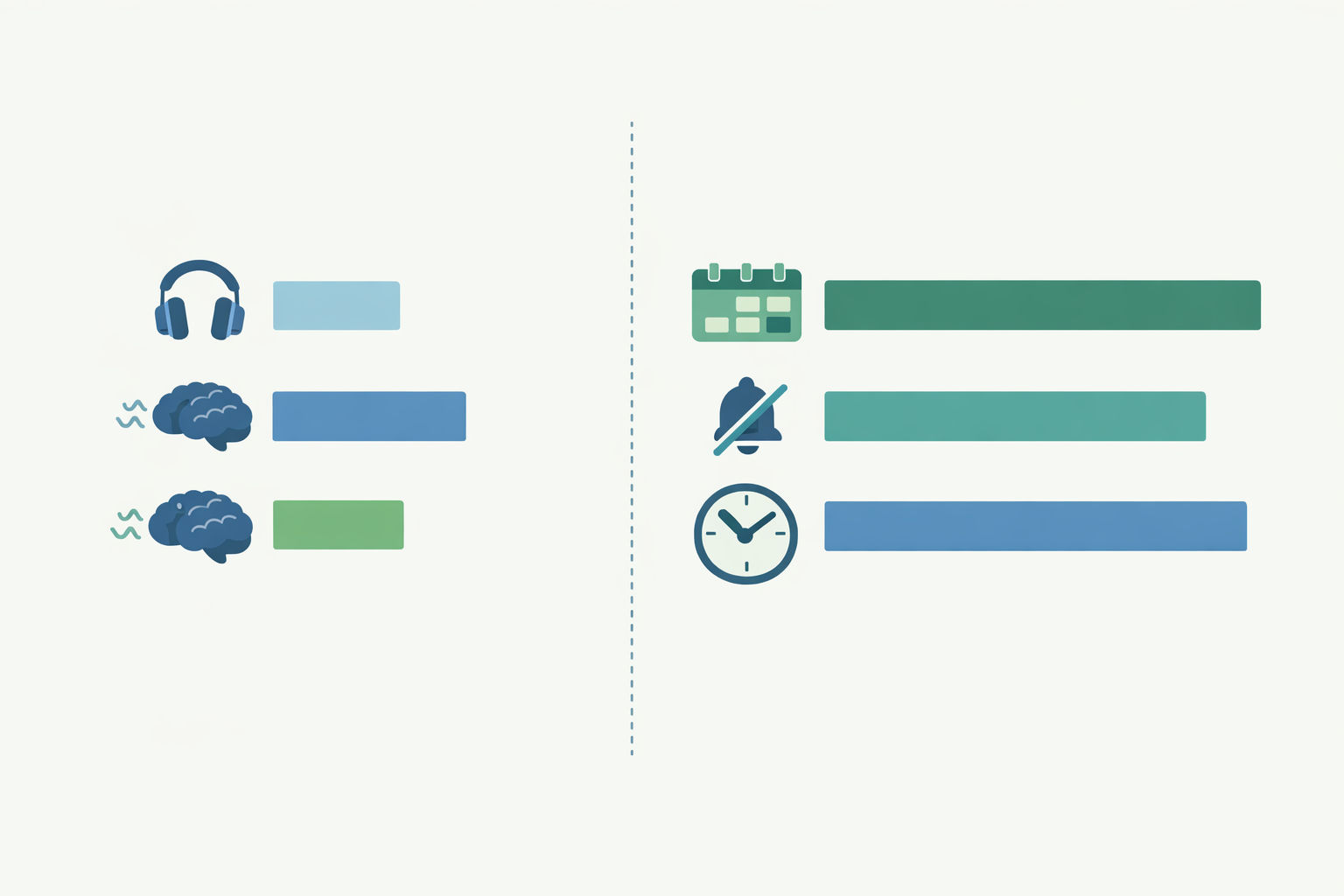
If you're optimizing for focus, the research evidence is far more robust for:
- Time blocking your deep work into protected, scheduled sessions
- Disabling notifications during focused blocks (Gloria Mark's research)
- Structuring your day around cognitive load — matching demanding tasks to your peak alertness window
- Reducing context switches — each interruption costs up to 23 minutes of recovery time
- Protecting unbroken 90-minute work blocks aligned to your brain's natural focus cycles
These aren't as exciting as "play a sound and get focused." But the effect sizes are larger and the evidence base is deeper.
The Bottom Line
Binaural beats are an interesting auditory phenomenon with a plausible theoretical basis. Some controlled studies show modest positive effects on attention tasks. But a 2023 systematic review of the core mechanism — brainwave entrainment — found it unsupported in the majority of studies. Effect sizes are moderate at best, sample sizes are small, and the placebo confound hasn’t been adequately addressed.
The honest conclusion: binaural beats may function as a useful focus ritual for some people, but they’re not a neurological shortcut. The productivity interventions with the strongest evidence — scheduling tasks by cognitive load, protecting deep work blocks, eliminating notification-driven interruptions — don’t come through your headphones. They come through how you structure your day.
One often-overlooked structural factor is when in your day you attempt deep work. Your chronotype determines your peak cognitive hours — and doing your most demanding work outside that window makes focus harder regardless of what you’re listening to. Your physical and digital workspace also plays a role most people underestimate: environmental design research shows that up to 40% of productive output is controlled by invisible defaults, friction, and context cues in your environment — factors that operate independently of any auditory intervention.
Understanding what actually happens in the brain during deep focus also clarifies why structural conditions — not auditory inputs — determine whether you enter a genuinely different cognitive state. The transient hypofrontality and neurochemical cascade that characterise flow state are downstream of getting the preconditions right — clear goals, challenge-skill balance, and uninterrupted focus — not of what’s playing through your headphones. If you find binaural beats help you settle into work, use them. Just don’t mistake the headphones for the strategy.
Structure Your Focus Blocks — Not Just Your Playlist
Daybook is a keyboard-first daily planner built for time blocking and deep work scheduling. Plan your day in plain text, protect your focus blocks, and build the kind of structure the research actually supports.
Try Daybook Free