Flow State at Work: What Csikszentmihalyi's Research Actually Says (and How to Get There Reliably)
The pop-psychology version of 'flow' distorts what the research actually found. Here's what Csikszentmihalyi measured, what happens neurologically during flow, the four preconditions that reliably produce it — and why 3-4 hours a day is your ceiling.
The flow state science that most productivity content references bears only a passing resemblance to what Mihaly Csikszentmihalyi actually studied. His research wasn’t about “hacking” your brain or unlocking “500% productivity.” It was a decades-long investigation into the structure of optimal experience — what makes certain moments feel genuinely absorbing, and what conditions produce them reliably.
If you’ve ever lost two hours to a coding problem, a writing session, or an architectural decision and emerged wondering where the time went, you’ve experienced what Csikszentmihalyi spent his career documenting. The question isn’t whether flow exists. It’s whether you can engineer the conditions that produce it — and what the evidence actually supports on that front.
What Csikszentmihalyi Actually Measured
Csikszentmihalyi didn’t invent flow through armchair theorizing. Starting in the 1970s, he pioneered the Experience Sampling Method (ESM): giving subjects pagers that buzzed at random intervals throughout the day, then having them record exactly what they were doing, how they felt, and how engaged they were. Over decades, this produced thousands of real-time data points across artists, surgeons, athletes, factory workers, and chess players.
From this data, he defined flow as “a state in which people are so involved in an activity that nothing else seems to matter; the experience is so enjoyable that people will continue to do it even at great cost, for the sheer sake of doing it” (Flow: The Psychology of Optimal Experience, 1990).
He identified eight components that characterize the experience:
Csikszentmihalyi's eight components of flow, adapted from Flow: The Psychology of Optimal Experience (1990)
Component
What It Means in Practice
Clear goals
You know exactly what needs to happen next — not the final outcome, but the immediate next step
Immediate feedback
You can tell in real time whether what you're doing is working
Challenge-skill balance
The task stretches your abilities without overwhelming them
Intense concentration
Attention narrows to a limited field of stimuli
Merging of action and awareness
You stop observing yourself performing — you just perform
Loss of self-consciousness
The inner critic goes quiet
Distorted time perception
Hours feel like minutes (or occasionally, minutes feel stretched)
Autotelic experience
The activity becomes intrinsically rewarding — you'd do it without external incentive
Critically, Csikszentmihalyi distinguished between the preconditions that trigger flow (clear goals, feedback, challenge-skill balance) and the experiential characteristics of being in flow (time distortion, loss of self-consciousness). Much of the popular confusion around flow conflates these — treating the subjective experience as something you can will into existence, rather than a downstream effect of getting the preconditions right.
A 2015 meta-analysis by Fong et al. in The Journal of Positive Psychology examined 28 studies and confirmed that challenge-skill balance, clear goals, and sense of control were the strongest antecedents of flow — but noted that the relationship between challenge-skill balance and flow was “moderate,” not deterministic. Flow isn’t a vending machine. Set the conditions, and you increase the probability. That’s the honest framing.
The Neuroscience: What’s Actually Happening in Your Brain
Csikszentmihalyi described the subjective experience. The neuroscience came later, and it tells a specific — if still debated — story about what flow looks like from inside the skull.
The dominant theory is transient hypofrontality, proposed by neuroscientist Arne Dietrich in 2003. The hypothesis: during flow, the prefrontal cortex — the brain region responsible for self-monitoring, planning, time perception, and executive judgment — temporarily reduces its activity. The brain shifts processing resources away from the explicit system (conscious, analytical thinking) toward the implicit system (pattern recognition, sensorimotor processing, automatic execution).
Dietrich developed this theory while training for triathlons during his doctorate at the University of Georgia. He noticed that during long runs, his higher cognitive functions — self-criticism, time awareness, analytical thought — seemed to quiet down. As he told BrainFacts.org: “I realized the way my cognition and my emotion changed were really the kinds of things that you typically attribute to the frontal cortex.”
This is directly connected to what cognitive load theory tells us about working memory: when the prefrontal cortex is freed from executive overhead — decision-making, self-monitoring, task-switching — it can redirect that capacity toward execution. Flow isn’t the brain working harder; it’s the brain working more efficiently within its actual bandwidth constraints.
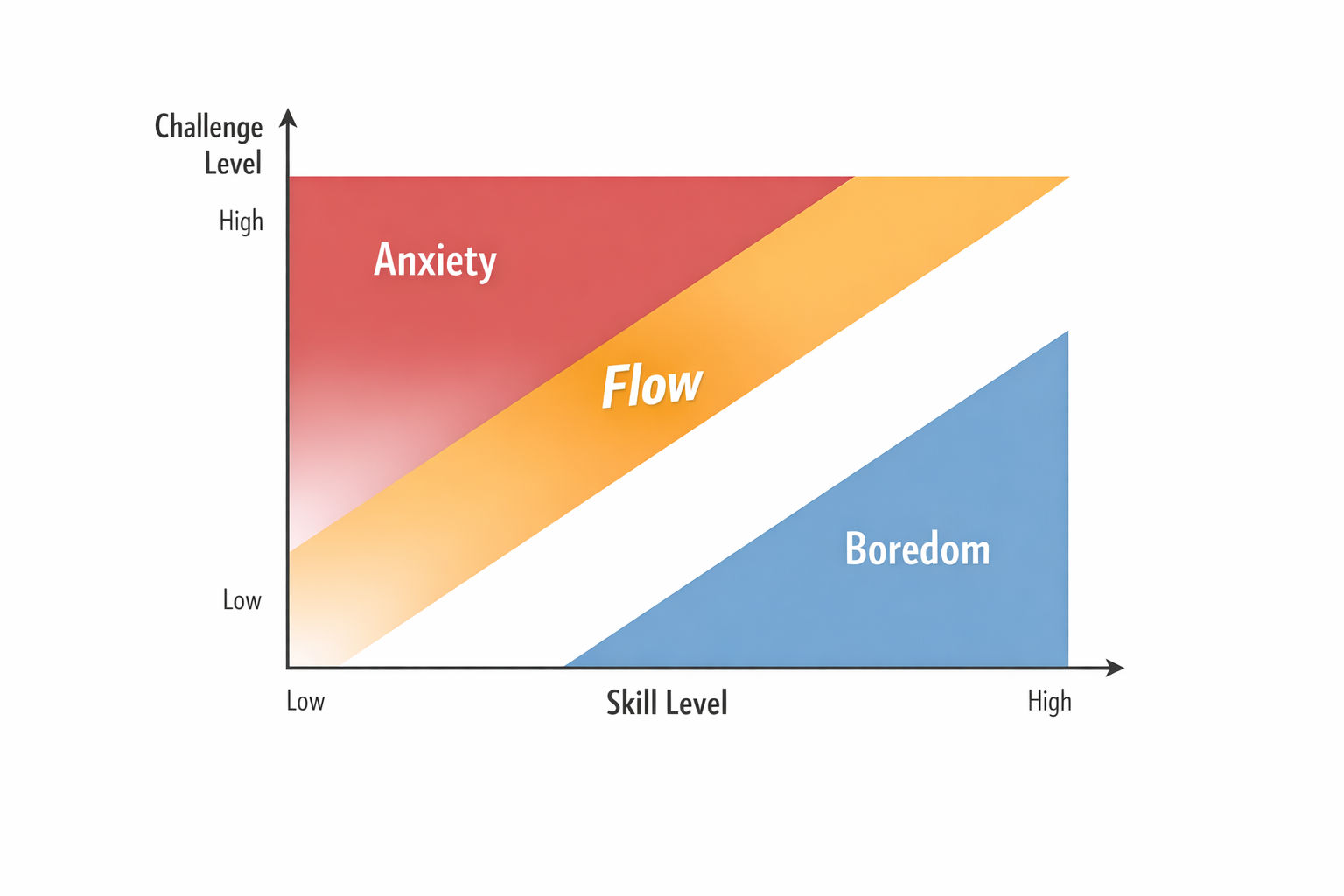
Csikszentmihalyi's flow channel: flow occurs in the narrow band where challenge and skill are both high and roughly matched.
The supporting evidence is growing but not conclusive. A 2008 fMRI study by Limb and Braun at the National Institutes of Health had jazz pianists improvise inside a scanner and found significantly reduced activity in the dorsolateral prefrontal cortex during improvisation. Ulrich et al. found deactivation of the medial prefrontal cortex during flow induced by a lab task. EEG research shows transitions from beta waves (analytical thinking) toward alpha-theta patterns during deep engagement.
The neurochemical picture adds another layer. According to research compiled by Steven Kotler and the Flow Research Collective, flow states involve a cascade of five neurochemicals: dopamine (focus, pattern recognition), norepinephrine (arousal, attention), endorphins (pain reduction), anandamide (lateral thinking), and serotonin (the post-flow sense of satisfaction). This combination explains why flow feels so good — and why Csikszentmihalyi found people would pursue flow-producing activities “even at great cost.”
A Note on the Evidence
Transient hypofrontality is a compelling theory, but it remains a hypothesis with supporting evidence from small neuroimaging studies — not an established fact. Dietrich himself acknowledges the neural mapping needs refinement. The 2022 literature review by Kotler et al. in Neuroscience & Biobehavioral Reviews calls for more rigorous experimental designs. What we can say: something measurable happens in the prefrontal cortex during flow-like states. Exactly what, and how consistently, is still being mapped.
The Four Preconditions: What the Evidence Supports
Strip away the seventeen-trigger frameworks and the neurochemical cascades, and Csikszentmihalyi’s original research points to four core preconditions for flow. Each has independent empirical support.
1. Clear, Immediate Goals
Flow requires moment-to-moment clarity about what needs to happen next. Not “finish the project” but “write this function,” “solve this constraint,” “draft this paragraph.” The granularity matters: when goals are too large or abstract, attention fragments into planning, evaluation, and anxiety about the gap between where you are and where you need to be.
This aligns with Peter Gollwitzer’s research on implementation intentions — specific plans that define the when, where, and how of action increase task completion rates significantly. The mechanism is the same: clear goals reduce the prefrontal cortex’s decision-making load, freeing resources for execution.
2. Immediate Feedback
Flow requires real-time information about whether what you’re doing is working. The programmer sees the test pass or fail. The writer rereads the sentence and knows whether it lands. The designer sees the layout take shape.
This is why some tasks are natural flow producers and others aren’t. Writing code with tight feedback loops (write, run, test, iterate) is structurally compatible with flow. Preparing a quarterly report that won’t be reviewed for two weeks is not.
3. Challenge-Skill Balance
This is Csikszentmihalyi’s central variable. The task must be difficult enough to demand full engagement but not so difficult that it produces anxiety. Kotler’s research with the Flow Research Collective suggests the optimal stretch is approximately 4% above your current skill level — enough to require focused effort, not enough to trigger frustration.
The 2015 Fong meta-analysis confirmed challenge-skill balance as a “robust contributor” to flow, but with important nuance: the relationship was moderate (not overwhelming), and weaker in work and education contexts than in sport or leisure. The implication for knowledge workers: challenge-skill balance is necessary but not sufficient. You also need the other conditions.
4. Freedom from Interruption
This isn’t one of Csikszentmihalyi’s original listed components, but it’s implicit in every one of them. Flow requires sustained, concentrated attention — and the research on interruptions makes clear how fragile that attention is.
Gloria Mark’s research at UC Irvine found that knowledge workers take an average of 23 minutes and 15 seconds to fully regain deep focus after a single interruption. Workers self-interrupt or switch tasks every 3 minutes and 5 seconds. Research suggests it takes approximately 15 minutes of uninterrupted focus to begin entering a flow state — meaning a single interruption doesn’t just break flow, it resets the entire entry process. For a deeper look at why this happens at the neurological level and what to do about it, see our piece on attention residue and the hidden cost of task-switching.
One highly practical approach to defending this uninterrupted time is task batching — grouping shallow, reactive work (email, Slack, admin) into dedicated time windows so your deep work blocks stay structurally clear. Batching doesn’t just reduce switches; it removes the temptation to switch, which Leroy’s research shows creates attention residue even before you act on it.
It’s also worth noting that when in the day you attempt flow matters as much as how long you protect. Your chronotype determines your biological peak hours — the windows when your prefrontal cortex is freshest and the neurochemical conditions for deep engagement are most favourable. A 90-minute block at the wrong time in your circadian cycle is structurally disadvantaged from the start.
Why Most Offices Are Structurally Hostile to Flow
Once you understand the preconditions, a depressing reality becomes clear: the standard knowledge work environment is designed to prevent every single one of them.
Unclear goals. Most knowledge workers start their day without a clear definition of what their highest-priority work is. They open email, react to Slack, attend standups, and assemble their priorities from the chaos of incoming requests. The prefrontal cortex stays in planning mode rather than shifting to execution.
Delayed feedback. Many knowledge work tasks have feedback cycles measured in days or weeks — a proposal sent for review, a design awaiting stakeholder input, a strategy document that won’t be discussed until the next meeting.
Mismatched challenge-skill ratio. Most people’s workdays oscillate between tasks that are trivially easy (email, status updates) and tasks that are ambiguously complex (“figure out the product strategy”). The sweet spot where challenge meets skill gets bypassed in both directions.
Constant interruption. This is the most measurable damage. As we’ve covered in our research on meeting overload and calendar fragmentation, knowledge workers now spend 40-60% of their time in meetings. Add Slack notifications, email, and ad hoc requests, and the average knowledge worker gets roughly one hour of true uninterrupted focus per day.
One hour. Out of eight. And flow requires at least fifteen minutes just to begin entering the state.
Being completely involved in an activity for its own sake. The ego falls away. Time flies. Every action, movement, and thought follows inevitably from the previous one, like playing jazz.
Engineering Flow: A Protocol Grounded in the Evidence
The research doesn’t support the idea that you can flip a switch and enter flow on command. What it does support: you can systematically arrange the preconditions and dramatically increase the probability of flow occurring. Here’s how, based on the evidence.
A Research-Backed Flow Protocol for Knowledge Workers
Step 1
Define the next concrete action before you begin
Not the project goal — the immediate next step. "Write the data validation logic for the checkout form" beats "work on the checkout feature." This satisfies the clear goals precondition and reduces prefrontal decision-making load. In Daybook, this means writing your task as a specific action, not an open-ended category.
Step 2
Select tasks at the 4% stretch
Choose work that's challenging enough to demand your full engagement but within your competence. If you're a senior developer, that's architecture work or a novel integration — not updating config files. If a task is too easy, add constraints (tighter deadline, better performance target). If it's too hard, break it into smaller sub-problems until you find the skill-challenge sweet spot.
Step 3
Block a 90-minute window aligned with your ultradian rhythm
Nathaniel Kleitman's research on ultradian rhythms shows the brain naturally cycles through 90-120 minute periods of high alertness followed by 20-30 minute troughs. Ericsson's research on elite performers found they practiced in ~90-minute sessions. Block your most cognitively demanding work into these windows — ideally in the morning when prefrontal resources are freshest. For the full evidence behind these cycles, see our guide to the [ultradian rhythm and the 90-minute work cycle](/blog/ultradian-rhythms-and-the-90-minute-work-cycle-what-the-research-actually-says-1773842952653).
Step 4
Eliminate all interruption vectors for the full block
Close Slack. Close email. Silence your phone. If you're in an open office, put on noise-cancelling headphones. Given that a single 5-second interruption can triple error rates on complex tasks and restart a 15-minute flow-onset clock, this isn't optional — it's the single highest-leverage action you can take.
Step 5
Engineer tight feedback loops into your task
Write code in small increments and run tests after each change. Draft a section and reread it immediately. Design a component and preview it in real time. The shorter the gap between action and feedback, the more the task's structure supports sustained flow.
Step 6
Respect the recovery phase
After 90 minutes, stop. Walk, stretch, stare out a window. Ericsson's research shows elite violinists napping between practice sessions. Andrew Huberman's neuroscience research suggests acetylcholine and dopamine levels drop after ~90 minutes of deep focus. Working through the trough doesn't produce more flow — it produces diminishing returns.
This protocol maps directly onto a time-blocking approach — which is no coincidence. Time blocking works for the same reasons flow preconditions do: it creates implementation intentions, reduces decision overhead, and protects contiguous focus blocks from interruption.
Realistic Expectations: The 3-4 Hour Ceiling
Here’s where the flow conversation needs the most honesty. The research consistently points to an upper limit on sustained deep cognitive work — and it’s lower than most people assume.
Anders Ericsson’s research on expert performance across multiple domains — violinists, chess grandmasters, athletes — found that elite performers sustained deliberate practice for roughly 3.5 hours per day, typically split into two sessions. Not more. Cal Newport estimates 3-4 hours of genuinely deep work per day as the practical ceiling for knowledge workers.
A McKinsey survey of over 5,000 executives found that most spend less than 10% of their work time in flow-like peak states. Some reported up to 50%, but that was the exception, not the norm.
This means a realistic target for a knowledge worker isn’t eight hours of flow. It’s two 90-minute blocks — roughly three hours of genuine deep focus state per day. If you can consistently achieve that, you’re operating at the level of elite performers.
The Math That Matters
If flow makes you even 2-3x more productive (the McKinsey survey found executives self-reported 5x at peak), then 3 hours of flow-state work per day produces as much as 6-15 hours of fragmented, interrupted work. The goal isn't more hours of flow. It's protecting the few hours you can realistically sustain and making the rest of your day support them.
Applying This to Your Daily Schedule
The practical takeaway from flow state science isn’t a new productivity system. It’s a filter for evaluating your existing one.
Ask yourself: does your daily schedule protect at least one 90-minute block for work that meets the four preconditions? Is that block positioned during your biological peak? Have you eliminated interruption vectors for that period?
If you schedule tasks by cognitive load rather than deadline urgency, you naturally create flow-compatible conditions: high-challenge work gets placed in high-alertness windows, low-demand tasks fill the troughs, and your most valuable cognitive work isn’t competing with Slack for prefrontal resources.
Understanding what actually happens in your brain during deep focused effort also clarifies why the flow preconditions matter at a biological level — the transient hypofrontality, the LC-NE exploitation mode, the myelination — these aren’t abstractions, they’re the mechanisms Csikszentmihalyi’s preconditions are activating.
It’s also worth considering the willpower science behind this: research after the ego depletion replication crisis shows that self-control is not a finite fuel reserve. The implication is that protecting your flow conditions shouldn’t depend on willpower — it should depend on structural design. Build the schedule so that focus is the default, not the exception.
In Daybook, this looks like front-loading your plan with one or two deep work blocks defined by specific actions — not categories — and using the plain-text format to keep planning itself fast enough that it doesn’t consume the focus it’s meant to protect.
Flow isn’t magic. It’s not a hack. It’s a well-documented neurological state with known preconditions and real upper limits. The research says you can’t sustain it all day — but you can stop accidentally preventing it. For knowledge workers, that shift alone is worth more than any productivity technique that ignores the science behind it.
Design Your Day for Flow
Daybook is a keyboard-first daily planner built for knowledge workers who take focus seriously. Define specific tasks, block time for deep work, and protect the conditions that produce flow — in plain text, without the overhead.