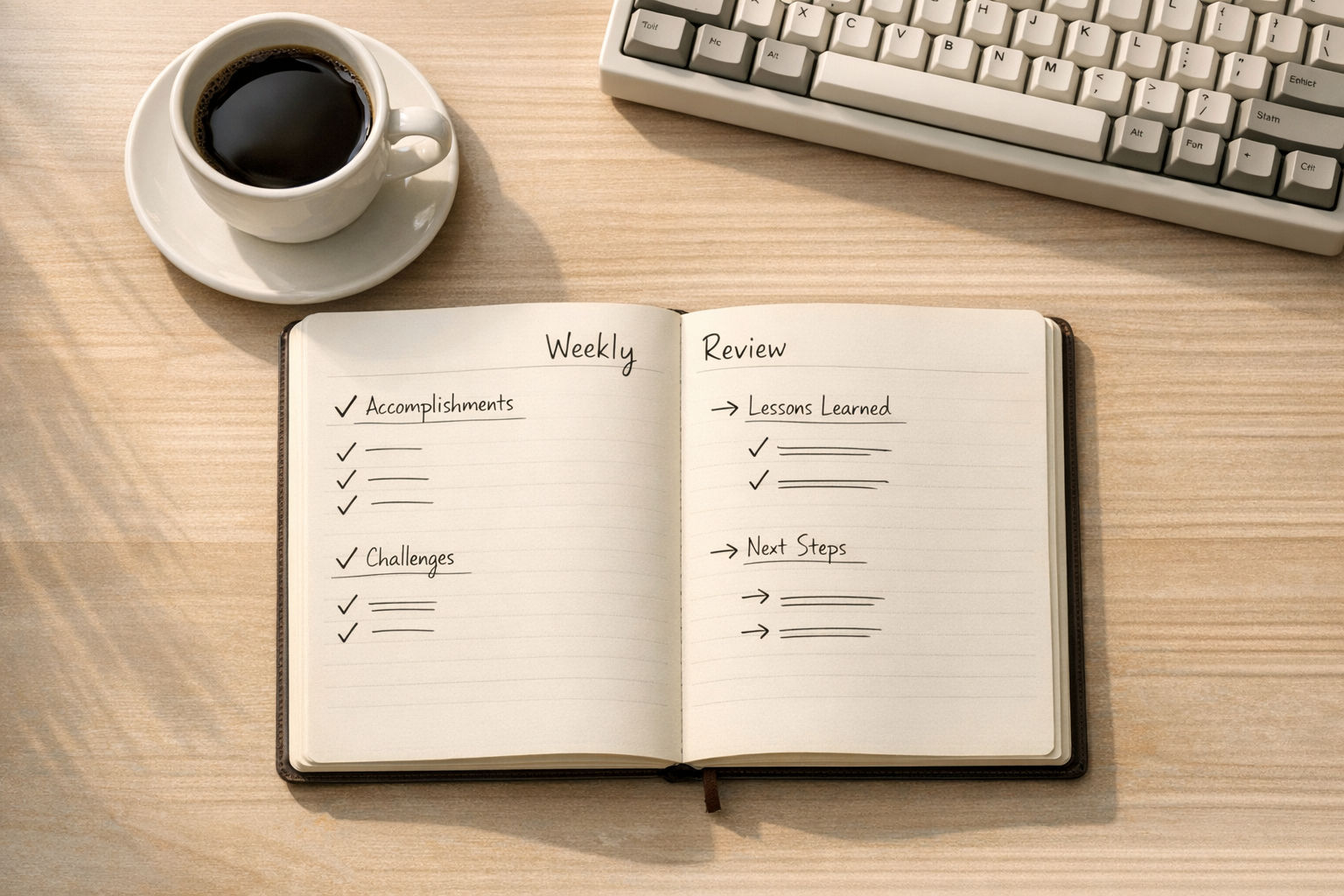
The weekly review GTD practitioners know as the system’s linchpin has a strange reputation: universally praised, almost universally skipped.
David Allen calls it the “critical success factor” in Getting Things Done. One informal survey of 127 GTD adopters found that 78% of people who do weekly reviews consistently consider themselves successful practitioners — while only 12% of those who abandoned GTD ever reviewed consistently. The correlation between review consistency and system survival was stronger than tool choice, training method, or job type.
The weekly review isn’t a scheduling ritual. It’s a cognitive maintenance process. And the research on why it works has become considerably stronger than what Allen could cite when Getting Things Done was published in 2001. The problem was never the concept. It was the execution — too long, too vague, too easy to skip when you’re already behind.
This post covers what Allen actually prescribed, what the cognitive science adds, and how to build a lean version that takes 30 minutes and targets the three mechanisms that make the review worth doing.
What David Allen Actually Prescribed
Allen’s weekly review isn’t a planning session. It’s structured across three phases — Get Clear, Get Current, and Get Creative — which expand into 11 steps in his official checklist.
Get Clear means processing every inbox to zero: email, physical papers, notes, loose commitments. You do a complete mind dump. Nothing stays in your head.
Get Current means reviewing your calendar (past and upcoming), updating your project list, checking your waiting-for items, and ensuring every active project has a defined next action.
Get Creative means lifting your eyes to the horizon — reviewing your goals, areas of responsibility, and longer-term outcomes. This is where new projects get born.
The full process, done faithfully, takes 60–90 minutes. Allen himself acknowledges this. And that’s the first reason people abandon it: in a week where you’re already drowning, carving out 90 minutes for a process that produces no visible output feels irresponsible.
But the research suggests you don’t need all 11 steps. You need three specific cognitive operations that Allen’s framework happens to contain.
The Research Case: Three Mechanisms That Make the Weekly Review Work
The GTD weekly review works not because of its checklist, but because it activates three well-documented cognitive mechanisms. Understanding these explains both why the review is effective and which parts you can’t afford to skip.
1. Closing Open Loops (The Zeigarnik Effect)
In 1927, psychologist Bluma Zeigarnik observed that waiters remembered unpaid orders far better than completed ones. Her subsequent research established a principle: unfinished tasks persist in working memory, consuming cognitive resources until they’re resolved.
The productivity implication is straightforward — every uncommitted task, unanswered email, and half-formed idea occupies mental bandwidth whether you’re consciously thinking about it or not. David Allen’s phrase “open loops” maps directly onto this. For a deep investigation into what the research actually supports — and where the original findings didn’t replicate — see The Zeigarnik Effect and Productivity: Why Unfinished Tasks Hijack Your Brain.
But the critical update came from Masicampo and Baumeister in 2011. Their research, published in the Journal of Personality and Social Psychology, demonstrated that you don’t need to complete a task to close the loop — you just need to make a specific plan for it. Across five studies, they showed that unfulfilled goals caused intrusive thoughts during unrelated tasks and impaired performance on tasks requiring executive function. But when participants formulated concrete plans for those unfulfilled goals, the interference effects disappeared entirely.
This is the scientific foundation for Allen’s “Get Clear” phase. The mind dump and inbox processing aren’t busywork. They’re a systematic method for closing cognitive loops through plan-making — which is exactly what the research says works. And this is the same mechanism that attention residue research identifies as the root cause of fragmented focus: the mental traces of incomplete work that linger in working memory and degrade your capacity for whatever you’ve switched to.
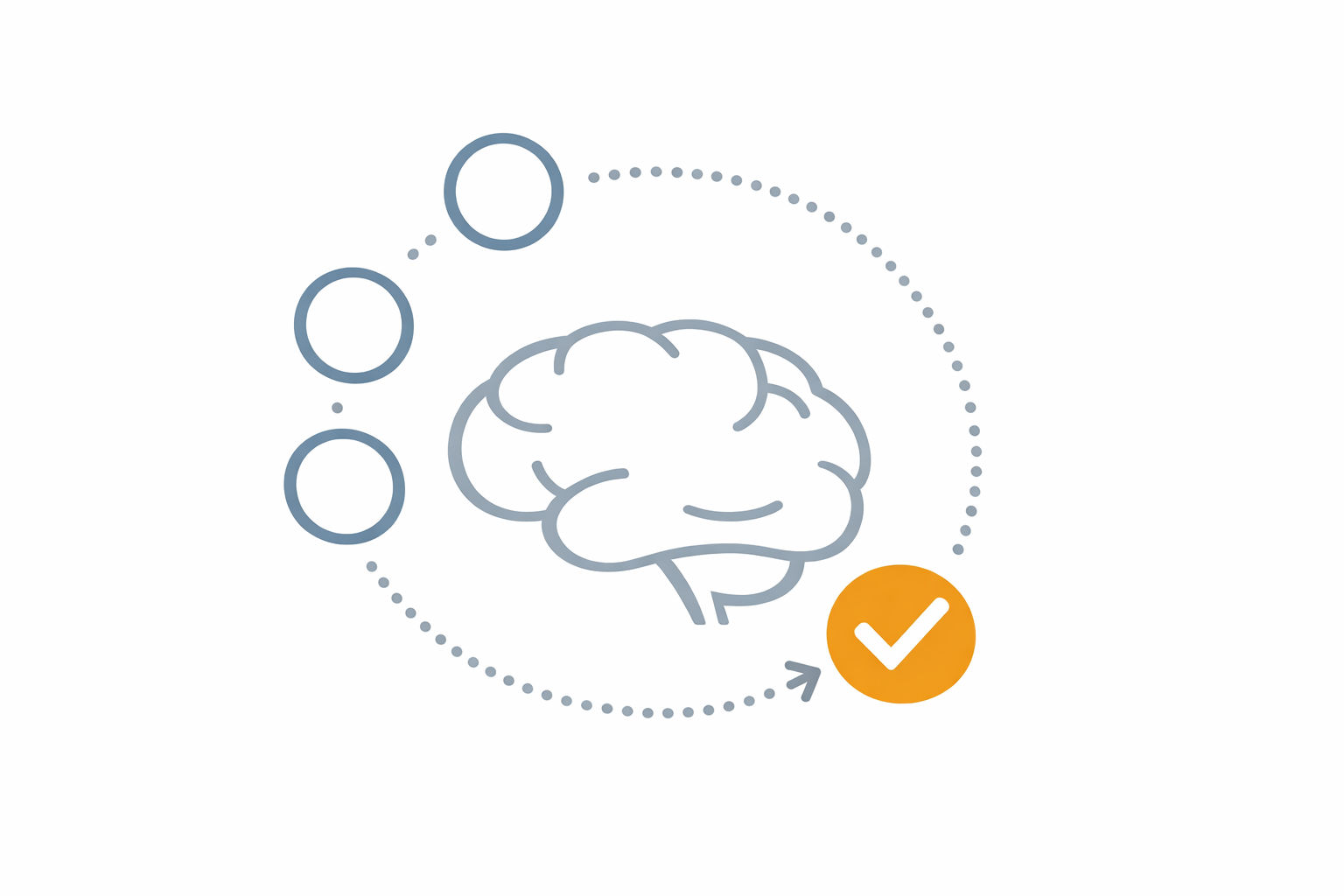
Unfinished tasks consume cognitive resources until they're either completed or assigned a concrete plan — a finding that validates GTD's core insight.
3. Implementation Intentions (The Horizon Scan)
The third mechanism is what Allen’s “Get Creative” phase provides: connecting your weekly actions to your larger goals. The research literature calls this forming implementation intentions.
Peter Gollwitzer’s research, spanning decades and synthesized in a 2006 meta-analysis of 94 studies (N > 8,000), shows that specifying when, where, and how you’ll act on a goal raises completion rates dramatically. For difficult goals, completion jumped from 22% to 62% when participants formed implementation intentions. The overall effect size across the meta-analysis was d = 0.65 — a medium-to-large effect.
A weekly review is one of the few natural contexts where implementation intentions form organically. When you scan your project list and calendar together, you’re not just scheduling — you’re linking abstract commitments (“finish the proposal”) to concrete time slots and action steps (“Tuesday 9–11 AM, draft section 3 using the client’s revised brief”). That’s the exact mechanism Gollwitzer’s research describes.
If you use a quarterly goal framework alongside your weekly review, the connection becomes even more powerful. Research on personal OKRs for individual contributors shows that the weekly check-in cadence — scoring Key Results and identifying one high-leverage action for the coming week — is one of the two practices that determine whether ambitious quarterly goals survive contact with daily work. The weekly review is the structural mechanism that creates this cadence. And the goal setting science behind frameworks like OKRs and Locke & Latham’s research shows why specificity at the weekly planning level — not just the quarterly one — is where the performance effects are strongest.
3. Implementation Intentions (The Horizon Scan)
The third mechanism is what Allen’s “Get Creative” phase provides: connecting your weekly actions to your larger goals. The research literature calls this forming implementation intentions.
Peter Gollwitzer’s research, spanning decades and synthesized in a 2006 meta-analysis of 94 studies (N > 8,000), shows that specifying when, where, and how you’ll act on a goal raises completion rates dramatically. For difficult goals, completion jumped from 22% to 62% when participants formed implementation intentions. The overall effect size across the meta-analysis was d = 0.65 — a medium-to-large effect.
A weekly review is one of the few natural contexts where implementation intentions form organically. When you scan your project list and calendar together, you’re not just scheduling — you’re linking abstract commitments (“finish the proposal”) to concrete time slots and action steps (“Tuesday 9–11 AM, draft section 3 using the client’s revised brief”). That’s the exact mechanism Gollwitzer’s research describes.
The Three Mechanisms at a Glance
Closing open loops — Masicampo & Baumeister (2011): making a plan eliminates the cognitive interference of unfinished tasks.
Structured reflection — Di Stefano et al. (2014): 15 minutes of reflection → 22.8% performance improvement in 10 days.
Implementation intentions — Gollwitzer & Sheeran (2006): specifying when/where/how raises difficult goal completion from 22% to 62%.
A good weekly review activates all three. A bad one activates none.
Why You Skip It (The Planning Paradox)
If the evidence is this strong, why does the weekly review get abandoned so consistently?
The answer is a planning paradox: the people who most need reflection are least likely to do it. When you’re behind, stressed, or overloaded, reflection feels like a luxury. You default to doing — answering the next email, putting out the next fire — because action feels productive in the moment even when it’s not strategic.
This isn’t a character flaw. It’s a well-documented cognitive pattern. Research on decision fatigue shows that under cognitive load, people default to the status quo or the easiest available action. Under stress, the executive functions required for planning and reflection are exactly the resources that get depleted first.
Allen’s full 11-step, 90-minute review makes this worse. The activation energy required to start is high. The process itself demands sustained executive function. And the payoff — clarity, reduced anxiety, better decisions — is abstract and delayed. For someone already running a cognitive deficit, that’s a recipe for avoidance.
The solution isn’t discipline. It’s designing a review that’s short enough to survive a bad week.
A Lean Weekly Review: Five Steps, Thirty Minutes
This structure targets the three mechanisms above — closing loops, structured reflection, and implementation intentions — without the overhead of Allen’s full process. Each step is grounded in what the research says actually matters.
The 30-Minute Weekly Review
Step 1
Brain Dump (5 minutes)
Write down everything that's on your mind — tasks, worries, half-formed ideas, things you forgot to do. Don't organize. Don't prioritize. Just externalize. This directly targets the Zeigarnik effect: getting open loops out of working memory and into a trusted external system. Masicampo and Baumeister's research shows that even the act of recording a plan begins to close the cognitive loop.
Step 2
Process and Close Loops (8 minutes)
Go through your dump list and your existing task list. For each item, decide: Does this need a next action? If yes, write it down. If no, delete it or move it to a someday list. The key is specificity — 'work on the proposal' doesn't close a loop; 'draft the introduction using the revised client brief' does. You're manufacturing the specific plans that Masicampo and Baumeister showed eliminate cognitive interference.
Step 3
Review the Week (7 minutes)
Scan your calendar and completed tasks from the past week. Ask two questions: What worked? What didn't? This is Di Stefano's 15-minute reflection compressed. You're not journaling — you're extracting the one or two tactical lessons that change next week's behavior. Did that two-hour meeting block on Wednesday kill your afternoon focus? Note it. Did batching emails to 3 PM actually reduce interruptions? Keep it.
Step 4
Horizon Scan (5 minutes)
Open your project list or quarterly goals. For each active project, confirm the next concrete action. For your top 2–3 goals, ask: what am I doing this week that advances this? If you're using a quarterly OKR framework, this is your weekly check-in — score each Key Result and identify one action for the coming week. If the answer to 'what advances this?' is nothing, something needs to change. This is where implementation intentions form — connecting weekly actions to longer-term commitments. Gollwitzer's research shows this is where completion rates jump.
Step 5
Time Block the Week (5 minutes)
Place your highest-priority next actions into specific time slots on your calendar. You're not scheduling every minute — just the 3–5 tasks that matter most, anchored to specific days and times. Try to align deep-work blocks with your biological peak hours — chronotype research shows a 20–40% performance advantage when cognitively demanding work matches your circadian window. This converts abstract intentions into implementation intentions: 'I will do X at time Y in location Z.' The research shows this format is what separates goals that get completed from those that don't.
The 30-Minute Rule
If your review regularly exceeds 30 minutes, you're probably trying to do work inside the review instead of planning work. The review identifies next actions. It doesn't execute them. Keep these separate — the research on reflection shows the benefit comes from the metacognitive act itself, not from cramming more work into the session.
Making It Stick: Friction Is the Enemy
The research on habit formation and procrastination converges on the same principle: reduce the friction between intention and action. For the weekly review, that means two things.
First, anchor it to an existing routine. The most common failure mode is treating the review as a free-floating task that gets rescheduled indefinitely. Pick a fixed time — Friday at 4 PM, Sunday at 7 PM, Monday at 8 AM — and protect it. The specific day matters less than the consistency.
Second, minimize tool overhead. If your review requires opening four apps, loading a template, and navigating a complex interface, you’ve added activation energy that works against you during high-stress weeks. The review should start the moment you sit down.
This is where the medium matters. A plain-text, keyboard-first tool like Daybook removes the friction that heavyweight apps introduce. There’s nothing to click through, no templates to load, no context switching between views. You open it, start typing your brain dump, and you’re already in the review. When your planning tool operates at the speed of thought — keyboard shortcuts, plain text, no GUI overhead — the activation energy drops to near zero. That’s what makes the difference between a review that survives Week 3 and one that doesn’t.
The weekly review is not a productivity hack. It’s one of the most evidence-backed practices in the literature — a structured way to close cognitive loops, reflect on what’s working, and form the specific plans that research shows dramatically improve follow-through. Allen got the concept right. The research tells us why. And the lean version takes less time than most people spend deciding what to have for lunch.
Further Reading
- Di Stefano, G., Gino, F., Pisano, G., & Staats, B. (2014). “Learning by Thinking: How Reflection Aids Performance.” Harvard Business School Working Paper 14-093.
- Masicampo, E.J. & Baumeister, R.F. (2011). “Consider It Done! Plan Making Can Eliminate the Cognitive Effects of Unfulfilled Goals.” Journal of Personality and Social Psychology, 101(4), 667–683.
- Gollwitzer, P.M. & Sheeran, P. (2006). “Implementation Intentions and Goal Achievement: A Meta-Analysis.” Advances in Experimental Social Psychology, 38, 69–119.
- Allen, D. (2001). Getting Things Done: The Art of Stress-Free Productivity. Penguin Books.
- Schön, D.A. (1983). The Reflective Practitioner: How Professionals Think in Action. Basic Books.
Plan Your Week in Plain Text
Daybook is a keyboard-first daily planner built for the kind of focused, evidence-based planning the research supports. No templates. No clicking through menus. Just open it and think.
Try Daybook Free