AI as a Daily Planning Tool: What the Research on Cognitive Offloading Says About Thinking With Machines
AI productivity tools are everywhere — but is using AI for daily planning evidence-backed or just hype? Here's what cognitive offloading research, the Extended Mind Thesis, and the latest adoption data actually say.
You already offload your thinking to machines. You have for years.
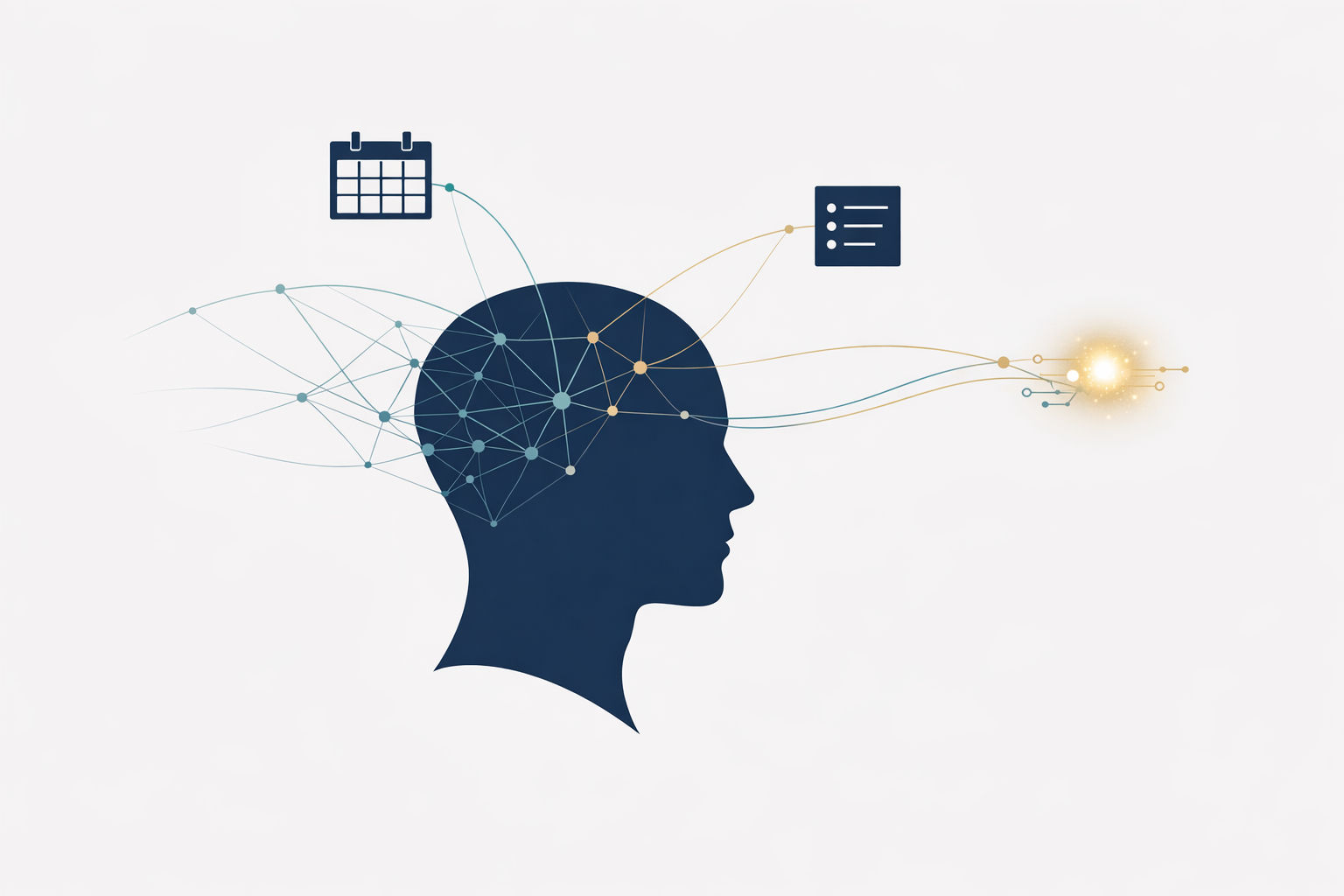
Every time you drop a meeting into your calendar instead of remembering it, jot a task into a to-do list instead of holding it in working memory, or set a phone reminder instead of mentally rehearsing a deadline — you’re doing what cognitive scientists call cognitive offloading. You’re externalizing mental work to reduce the load on your brain.
Now AI productivity tools are offering to do something more ambitious: not just store your plans, but help generate them. Reorganize your priorities. Surface what you’ve forgotten. Draft your day before you’ve had coffee.
The question isn’t whether this is useful — 75% of knowledge workers are already using AI at work, according to Microsoft and LinkedIn’s 2024 Work Trend Index. The question is whether it’s wise. What does the cognitive science actually say about outsourcing planning to external systems? And does AI meaningfully change the equation?
The answers are more nuanced — and more interesting — than most AI coverage suggests.
Your Brain Was Designed to Offload
The foundational paper here is Risko and Gilbert’s 2016 review in Trends in Cognitive Sciences, “Cognitive Offloading” — now cited over 1,500 times. Their central argument: offloading cognitive work to external tools isn’t a sign of intellectual weakness. It’s a strategic, metacognitive process.
In controlled experiments, participants offloaded roughly 40% of to-be-remembered items when given the opportunity to write them down — even without performance incentives. The decision to offload was driven by a kind of internal cost-benefit analysis: when people perceived a task as effortful, or when their confidence in their own memory was low, they were more likely to use external aids.
This matters because it reframes the entire conversation about AI daily planning. Offloading isn’t laziness. It’s the brain recognizing that working memory — which can hold roughly four items at a time, per current estimates — is a genuine bottleneck, and that externalizing certain tasks frees that capacity for higher-order thinking.
If you’ve ever noticed that writing down your tasks for the day makes you think more clearly about what matters, you’ve experienced this directly. The act of building a structured daily plan isn’t just about organization — it’s about freeing your working memory to do the kind of synthesis and judgment that actually moves work forward.
Offloading likelihood increases with perceived effort or low metacognitive confidence... individuals conduct a cognitive cost-benefit analysis to determine whether it is worth the effort to use internal resources or to offload the task to an external resource.
The Extended Mind: Why Your Notebook Is Part of Your Cognitive System
The philosophical backbone for this comes from Andy Clark and David Chalmers’ 1998 paper, “The Extended Mind.” Their argument, now a cornerstone of cognitive philosophy: cognition doesn’t stop at the skull.
Clark and Chalmers propose what they call the parity principle: if a process in the external world functions the same way as a cognitive process in the head, it should count as cognitive — period. Their famous thought experiment compares Otto, who has Alzheimer’s and relies on a notebook for directions, with Inga, who remembers them internally. Clark and Chalmers argue that Otto’s notebook is part of his cognitive system, functionally equivalent to Inga’s biological memory.
Annie Murphy Paul extended this framework to modern knowledge work in her 2021 book The Extended Mind, arguing that our tools, environments, and social interactions are all legitimate components of how we think. The calendar on your screen, the to-do list in your planner, the weekly review process you run every Friday — these aren’t crutches. They’re cognitive architecture.
This gives a principled basis for using AI as a planning tool. If a static notebook qualifies as part of your extended mind, then an AI system that dynamically surfaces and organizes information is just a more capable version of the same cognitive partnership.
What’s Genuinely New About AI Productivity Tools
But here’s where the research gets more complicated. A notebook is inert. It holds what you put into it and nothing more. AI does something qualitatively different.
Unlike static external tools, AI can:
Reorganize your task list based on patterns it detects
Prioritize dynamically based on deadlines, dependencies, or context
Surface information you didn’t think to look for
Generate plans, agendas, and summaries from raw inputs
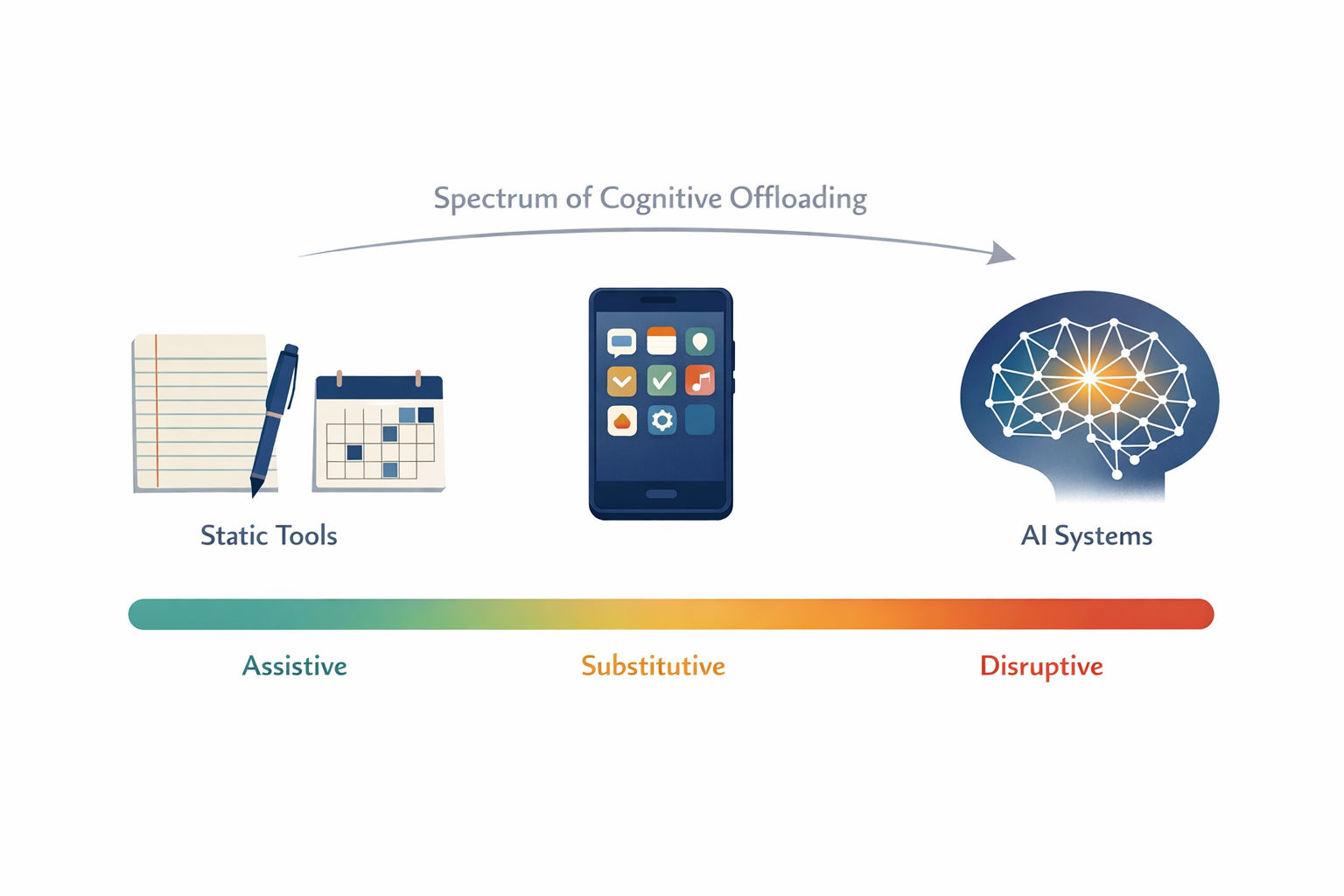
This is a different kind of cognitive partnership. Grinschgl and Neubauer, writing in Frontiers in Artificial Intelligence (2022), make an important distinction between AI technologies that support cognition and those that substitute for it. They note that modern AI tools “not only alter memory but also redistribute attention and mental effort” — which can go in two directions.
A 2025 study from Adobe Research and the University of Washington (Siu & Fok) found that domain experts welcomed AI assistance with repetitive information-gathering tasks, but “preferred to retain control over complex synthesis and interpretation activities that require nuanced domain understanding.” The researchers identified a core tension: “reducing cognitive load through automation” versus “maintaining the deliberate practice necessary for expertise development.”
In other words, offloading to AI is beneficial when it handles the extraneous cognitive load — the overhead that doesn’t contribute to the quality of your thinking. It becomes problematic when it starts handling the germane load — the productive struggle that builds real understanding and judgment.
The cognitive offloading spectrum: from assistive tools that support thinking to AI systems that risk substituting for it entirely.
The Dependency Warning: What GPS Taught Us About Offloading Too Much
The strongest cautionary evidence comes from an unexpected field: navigation.
Dahmani and Bohbot’s 2020 study in Scientific Reports tracked drivers over three years and found that increased GPS use predicted a steeper decline in hippocampal-dependent spatial memory — the ability to build mental maps and navigate without assistance. Crucially, the researchers established directionality: people didn’t use GPS more because they had poor spatial skills. Greater GPS use caused the decline.
As Dahmani and Bohbot wrote: “Those who used GPS more did not do so because they felt they had a poor sense of direction, suggesting that extensive GPS use led to a decline in spatial memory rather than the other way around.”
The mechanism is straightforward: when you offload a cognitive task consistently, the neural systems responsible for that task get less practice. The skill atrophies.
Apply this cautiously to daily planning. The GPS analogy isn’t perfect — navigation is a spatial skill with a well-defined neural substrate, while planning involves distributed executive functions. But the principle holds: if you consistently let AI decide what your priorities are, you may erode the judgment muscles that make those decisions possible in the first place.
This connects directly to what Microsoft Research warned about in a 2025 article on AI in knowledge work. Their own findings showed that using generative AI can lead workers to “produce a narrower range of ideas, put less effort into critical thinking, and retain less of what they write or read.” Senior researcher Advait Sarkar described the risk of becoming a “professional validator of robots’ opinions.”
The Performance Paradox
Research from the University of Technology Sydney identifies a concerning pattern: unstructured AI use often creates a performance paradox — short-term task performance improves while durable, long-term cognitive skills are harmed. The key differentiator is how you use AI: deep engagement and verification build skill; passive acceptance of AI output erodes it.
The 75% Figure: Evolution, Not Revolution
Microsoft and LinkedIn’s 2024 Work Trend Index found that 75% of global knowledge workers now use AI at work — with 46% having started within the previous six months alone. That’s one of the fastest technology adoption curves in workplace history.
But framed through the cognitive offloading lens, this isn’t as revolutionary as it sounds. Knowledge workers have always offloaded. We offloaded memory to notebooks, offloaded scheduling to calendars, offloaded decision overhead to structured review processes. AI is the latest — and most capable — link in a chain that stretches back to the first time someone scratched a reminder on a clay tablet.
What Clark and Chalmers predicted in 1998 is simply playing out at scale: cognition extends into whatever tools are available, as long as those tools are reliably coupled to the thinker’s workflow. The 75% figure isn’t a revolution. It’s confirmation that the extended mind thesis was right all along.
The real question has never been whether to offload. It’s what to offload — and what to protect.
A Practical Framework: What to Offload, What to Keep
Based on the research, here’s a defensible framework for using AI in daily planning without eroding the cognitive skills that matter.
Offload to AI: Capture, Triage, and Surfacing
These are classic extraneous-load tasks — overhead that doesn’t benefit from your sustained attention:
Capture: Let AI help gather scattered inputs — emails, Slack messages, meeting notes — into a single staging area. This is pure cognitive offloading in the Risko and Gilbert sense: reducing the memory burden of tracking where everything lives.
Triage: AI can sort, tag, and flag items by urgency, topic, or project. This is pattern recognition across a volume of data that would consume your working memory if done manually.
Surfacing: AI excels at reminding you what you’ve forgotten — the follow-up from last Tuesday, the deadline you haven’t accounted for, the context from a meeting two weeks ago.
Keep human: The actual prioritization
The question “what matters today, and why?” requires something AI fundamentally lacks: your contextual knowledge. You know that the Q3 report is technically due Friday but your CEO actually cares more about the product demo. You know that your energy is low today and the creative work should wait until tomorrow’s deep focus block. You know that a client relationship needs attention even though nothing is technically overdue.
These are judgment calls that draw on tacit knowledge, emotional awareness, and strategic context. They are exactly the kind of germane cognitive load that builds expertise when you practice it — and atrophies when you don’t.
A framework for which planning tasks to offload to AI and which to keep human, based on cognitive offloading research.
Task Type
Offload to AI?
Reasoning
Gathering scattered tasks and inputs
✅ Yes
Pure working memory overhead — no judgment required
Sorting by deadline or project
✅ Yes
Pattern matching AI handles efficiently
Surfacing forgotten commitments
✅ Yes
Reduces memory burden without replacing skill
Deciding today's top 3 priorities
❌ No
Requires tacit knowledge and strategic context
Estimating task duration
⚠️ Partially
AI can suggest based on history; you calibrate
Choosing when to do deep vs. shallow work
❌ No
Depends on energy, mood, and self-awareness
The Right Architecture: AI Feeds In, You Author the Plan
This framework points toward a specific kind of tool design: one where AI handles the information pipeline, but the human retains authorship of the plan itself.
This is the design philosophy behind keyboard-first, plain text planning tools like Daybook. The structure of your day is something you write — deliberately, in your own words, with your own priorities. It’s not generated for you by an algorithm that doesn’t know the difference between urgent and important in your specific context.
AI can feed useful information into that process. It can tell you what’s on your plate, what you might have missed, what your calendar looks like. But the act of sitting down and deciding — “here’s what I’m doing today, here’s why, here’s when” — is the cognitive exercise that keeps your planning muscles strong.
The Extended Mind Thesis doesn’t say your tools should think for you. It says your tools are part of how you think. There’s a critical difference. A well-designed planning tool extends your cognition by giving it structure. A poorly designed one replaces your cognition with someone else’s defaults.
The research is clear on this: the value of cognitive offloading comes from strategic use — offloading what doesn’t benefit from your attention so you can invest it where it matters. Not from wholesale delegation of the thinking itself.
The Bottom Line
AI productivity tools are a natural extension of cognitive offloading — a strategy your brain was already using. The research supports offloading capture, triage, and surfacing to AI. But the research also warns against offloading prioritization and judgment — the skills that atrophy without practice. Use AI to prepare the ingredients. Cook the meal yourself.
What the Research Actually Says: Key Takeaways
For the skeptics who want the citations, here’s the evidence base in summary:
Cognitive offloading is strategic, not lazy. Humans naturally and beneficially externalize cognitive work to free working memory for higher-order tasks (Risko & Gilbert, 2016, Trends in Cognitive Sciences).
Your tools are part of your mind. The Extended Mind Thesis establishes that external systems — including digital tools — are legitimate components of cognition when functionally integrated into your workflow (Clark & Chalmers, 1998).
But chronic offloading can erode skills. GPS dependency degrades spatial memory over time, and the effect is causal, not correlational (Dahmani & Bohbot, 2020, Scientific Reports). The same principle likely applies to planning skills.
AI offloading has a performance paradox. Short-term task performance improves, but unstructured AI use can narrow thinking and reduce retention (Microsoft Research, 2025; UTS, 2026).
Experts instinctively offload correctly. Domain experts delegate repetitive information gathering to AI but retain control of synthesis and interpretation (Siu & Fok, 2025).
75% of knowledge workers already use AI at work. The cognitive offloading impulse is already operating at scale (Microsoft/LinkedIn, 2024 Work Trend Index).
The pattern across all this research points to the same conclusion: offload the overhead, protect the judgment. That’s not a new principle — it’s what good planning systems have always done. AI just raises the stakes.
Plan Your Day With Intention
Daybook is a keyboard-first, plain text daily planner built on evidence-based productivity principles. AI can feed information in — but the thinking stays yours.