Ultradian Rhythms and the 90-Minute Work Cycle: What the Research Actually Shows
The '90-minute focus block' is everywhere — but most advice cites it without explaining the actual science. This post goes to Kleitman, Lavie, and Rossi's primary research and tells you what it actually shows, where it's solid, and where the popular version oversimplifies.
If you’ve spent any time reading about productivity, you’ve encountered this advice: work in 90-minute focus blocks, take a break, repeat. It’s presented as biological fact — your brain operates on ultradian rhythms, cycling between high and low arousal roughly every 90 minutes, and you should schedule your day accordingly.
The advice isn’t baseless. There is real research behind it. But the popular version — set a 90-minute timer, take a 20-minute break, rinse and repeat — compresses decades of sleep science into a prescription the original researchers never quite made. Here’s what Nathaniel Kleitman, Peretz Lavie, and Ernest Rossi actually found, where the evidence is solid, and where the productivity world has filled in gaps with extrapolation.
Kleitman and the Basic Rest-Activity Cycle
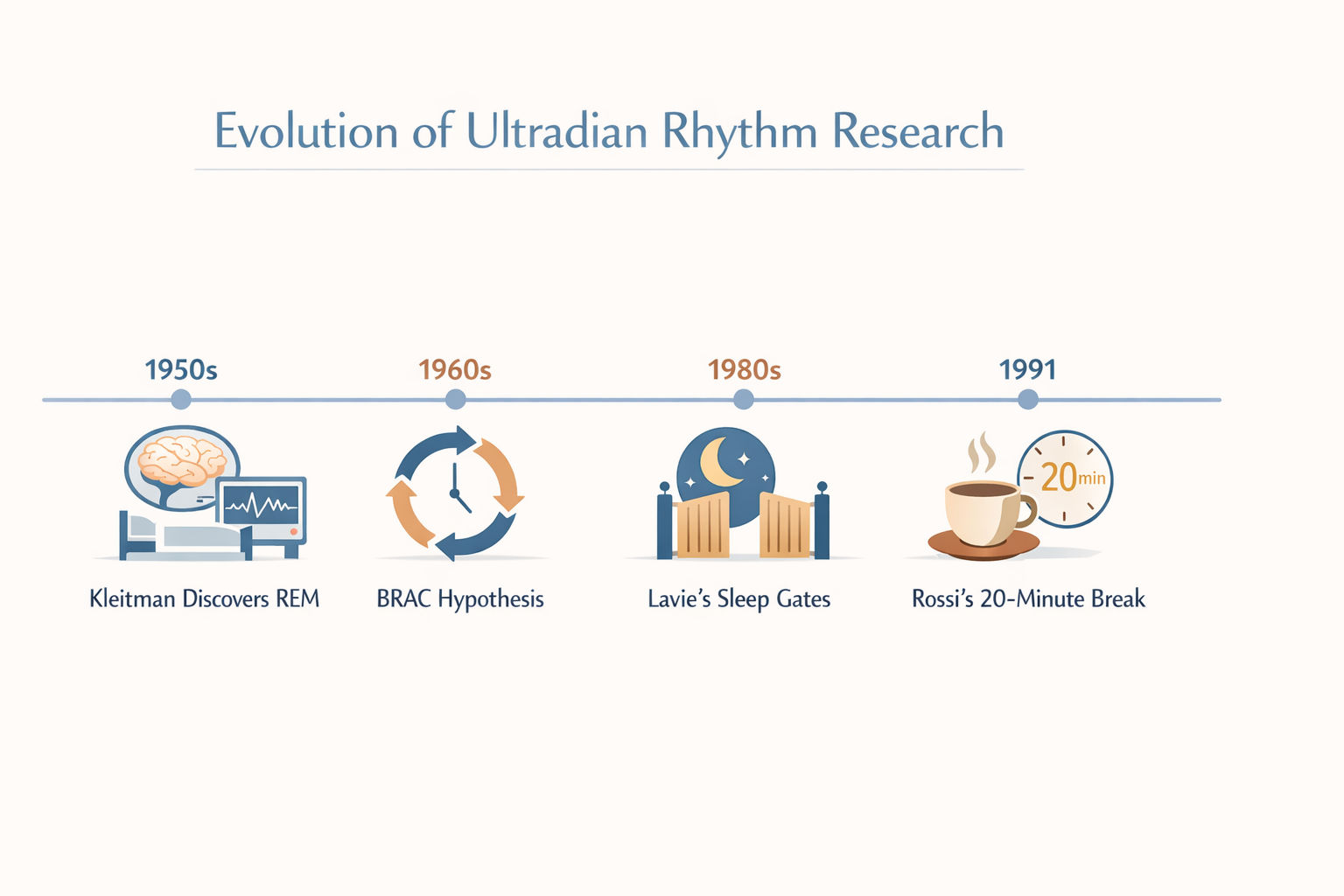
The story starts with Nathaniel Kleitman, a University of Chicago physiologist widely considered the father of modern sleep research. In 1953, Kleitman and his student Eugene Aserinsky discovered REM sleep — the phase of sleep associated with dreaming and rapid eye movements. They observed that REM periods recurred roughly every 90–110 minutes throughout the night, alternating with non-REM sleep in a predictable cycle.
In 1963, Kleitman proposed something bolder. In his book Sleep and Wakefulness, he hypothesized that this ~90-minute oscillation wasn’t limited to sleep. He called it the Basic Rest-Activity Cycle (BRAC) — a fundamental rhythm in nervous system functioning that continues during waking hours, though “obscured during wakefulness by the great surge of cortical activity.”
Kleitman’s own description was deliberately cautious. He wrote that “suggestions of its presence may be discerned in daytime oscillations in alertness, the often irresistible drowsiness after a big meal, and the relief that some persons get from brief catnaps.” This was a hypothesis, not a clinical finding. He observed that in human infants, the cycle was shorter — about 55–60 minutes — and progressively lengthened to 85–90 minutes in adults, suggesting a developmental biological rhythm.
The BRAC concept captured the imagination of researchers. But Kleitman was, as Lavie later noted, “somewhat vague about the properties of the BRAC” during wakefulness. The 90-minute sleep cycle was well-documented. Its waking counterpart was still a question mark.
Lavie’s Sleep Gates and Ultradian Performance Rhythms
Peretz Lavie, working at the Technion–Israel Institute of Technology, spent decades investigating Kleitman’s hypothesis with rigorous experimental methods. His approach was ingenious: the ultrashort sleep-wake paradigm. Subjects were placed on schedules like 7 minutes of sleep opportunity followed by 13 minutes of forced wakefulness (the 7/13 paradigm), cycled continuously for hours.
This allowed Lavie to map sleep propensity — the body’s tendency to fall asleep — across the entire day with fine-grained resolution. His findings were nuanced and important:
He identified an approximately 100-minute periodicity in sleep propensity, most prominent during the first four hours after waking.
He discovered “sleep gates” — windows when the body’s propensity to fall asleep spiked — and “forbidden zones for sleep” — periods (particularly around 8–10 PM) when falling asleep was remarkably difficult despite accumulated fatigue.
He found ultradian rhythms in multiple arousal indices: pupillary response to light, motor task performance, and EEG alpha rhythm density.
Critically, Lavie described these ultradian rhythms as a “multi-oscillatory phenomenon” rather than a single biological clock. The body doesn’t have one 90-minute timer. It has multiple overlapping oscillations in different physiological systems, and they don’t always synchronize neatly.
This cycle is obscured during wakefulness by the great surge of cortical activity, but suggestions of its presence may be discerned in daytime oscillations in alertness, the often irresistible drowsiness after a big meal, and the relief that some persons get from brief catnaps.
Rossi and the 20-Minute Break
Ernest Rossi, a psychologist and clinical hypnotherapist, took the BRAC concept and ran with it — further than the sleep researchers had. In his 1991 book The 20-Minute Break (co-authored with David Nimmons), Rossi popularized the idea that we should work in ~90-minute cycles and then take a 20-minute recovery period.
Rossi’s framework introduced two concepts that spread widely:
The Ultradian Stress Syndrome: when you override natural rest signals — fatigue, wandering attention, increased errors — your body accumulates stress markers, hormonal imbalances, and inflammation.
The Ultradian Healing Response: a 20-minute period of genuine disengagement that allows physiological recovery.
Rossi cited research from the Walter Reed Army Institute of Research showing that appropriate rest breaks every 90 minutes or so “dramatically reduced errors, accidents, and stress-related disorders” in radio operators, computer operators, and pilots. He also pointed to studies on naturalistic trance states in clinical hypnosis, where the typical self-hypnosis session lasted 15–20 minutes — a pattern he argued reflected the same underlying ultradian rest phase.
Here’s where intellectual honesty matters: Rossi’s contribution was primarily synthesis and extrapolation, not original experimental research on ultradian rhythms during wakefulness. He connected sleep science, military performance data, and clinical observations into a compelling narrative. Much of it is plausible. But the direct experimental evidence for a precisely timed 20-minute recovery window is thinner than the confident prescriptions that followed.
The evidence gap you should know about
A 1995 study by Broughton and Mullington tested 60 subjects every 10 minutes for 9 consecutive hours on cognitive tasks, alertness ratings, and heart rate. Using conservative statistical methods, they found no significant 90-minute periodicity in any measure. They concluded that some prior positive findings for the BRAC may have resulted from less rigorous statistical approaches. This doesn't disprove ultradian rhythms — but it does show that the "90-minute cognitive cycle" is far from a settled fact in the research literature.
What the Data Actually Shows — and Doesn’t
If you synthesize the primary research honestly, here’s where you land:
What’s well-supported:
During sleep, ~90-minute REM/non-REM cycles are well-documented and reproducible.
Ultradian oscillations in sleep propensity during waking hours exist, particularly in the first hours after waking (Lavie, 1981).
Multiple physiological systems show ultradian periodicity — but the cycles aren’t identical across systems and don’t always align.
Sustained cognitive work does degrade over time, and breaks improve subsequent performance. This is consistent with ultradian theory but doesn’t require it — attention fatigue research supports the same conclusion through different mechanisms.
What’s extrapolated:
The claim that cognitive performance follows a precise 90-minute rhythm during waking hours. The data range is 80–120 minutes, and at least one well-designed study (Broughton & Mullington, 1995) found no such rhythm at all.
The specific 20-minute recovery period. This comes primarily from Rossi’s clinical observations and synthesis, not from controlled experiments on break duration.
The idea that you can set a timer and ride a biological wave to peak performance. The original researchers described patterns and averages, not prescriptions.
What’s honestly unclear:
Whether waking ultradian rhythms are truly endogenous (driven by an internal clock) or partly artifacts of external schedules, meals, and activity patterns.
How much individual variation exists. Lavie noted “remarkable individual consistency” in his subjects — people had their own rhythms, but those rhythms weren’t identical across people.
The research lineage: from sleep physiology to productivity advice, each step involved more extrapolation.
The Ericsson Connection (and Misconnection)
Anders Ericsson’s research on elite violinists is often cited alongside ultradian rhythms as independent confirmation of the 90-minute work block. The story goes: the best violinists practiced in 90-minute sessions, therefore the 90-minute cycle is validated for knowledge work too.
The original 1993 study in Psychological Review tells a more nuanced story. Ericsson found that elite performers accumulated more total hours of deliberate practice and that they concentrated their most intense practice in the morning. But the paper primarily reports total weekly practice hours and lesson structures, not a specific finding about 90-minute session lengths. The convergence with ultradian theory is suggestive, but it’s not the independent replication it’s often presented as.
How to Actually Use This Research
The defensible takeaway from ultradian rhythm research isn’t “work for exactly 90 minutes.” It’s something more useful: your cognitive performance fluctuates throughout the day in patterns, and working with those patterns beats working against them.
Here’s how to apply that without cargo-culting the science:
Structuring your day around ultradian patterns
Step 1
Plan for 2–3 deep work blocks, not 5–6
The research consistently suggests that sustained high-focus work is physiologically limited. Elite performers in Ericsson's studies rarely exceeded 4 hours of deliberate practice daily. Charles Darwin famously worked in three 90-minute blocks. Plan your day around 2–3 genuine focus blocks and stop expecting sustained concentration across an 8-hour day.
Step 2
Use your own fatigue signals, not a timer
Instead of setting a 90-minute alarm, learn to notice your body's signals: wandering attention, increased error rate, the urge to check your phone, physical restlessness. These are the markers Rossi described as the onset of the ultradian rest phase. For some people, they arrive at 70 minutes. For others, 110. Track when they show up for you.
Step 3
Take genuine rest between blocks
The research is clear that the type of break matters. Scrolling social media or answering emails doesn't provide the physiological recovery the ultradian model describes. Walk, stretch, stare out a window, have a conversation about something unrelated to work. The Walter Reed research Rossi cited showed that genuine disengagement — not task-switching — reduced errors and stress markers.
Step 4
Front-load your hardest work
Lavie's research showed ultradian sleep propensity cycles were most prominent in the first hours after waking — which also corresponds to when circadian alertness peaks for most chronotypes. Your first deep work block of the day is likely your best one. Don't waste it on email.
Step 5
Track patterns over days, not minutes
Rather than optimizing individual sessions, look for patterns across a week. When do you consistently hit a wall? When does your best work happen? The individual consistency Lavie found in his subjects suggests your personal rhythm is relatively stable — but you need data to find it.
The gap between popular advice and primary research on ultradian rhythms
What Productivity Blogs Say
What the Research Actually Shows
Work in precise 90-minute blocks
Cycles range from 80–120 minutes and vary between individuals
Take exactly 20 minutes off
Rest duration is Rossi's synthesis, not from controlled experiments on break length
Your brain 'cycles' like clockwork
Lavie described a multi-oscillatory phenomenon — multiple overlapping rhythms, not one timer
Ericsson proved 90-minute practice sessions
The violin study measured total weekly practice hours, not session-level duration
Set a timer and ride the wave
Self-observation of fatigue signals is more supported than rigid scheduling
Planning Around Rhythms Without Over-Engineering
The practical value of ultradian rhythm research is directional, not prescriptive. It tells you that your day has a natural shape — periods of higher and lower cognitive capacity — and that planning around that shape is better than ignoring it.
This is where a simple planning tool beats a complex one. You don’t need an app that tracks your biometrics and auto-schedules your focus blocks. You need to block out 2–3 focused work periods in your daily plan, leave genuine gaps between them, and pay attention to what happens.
In Daybook, this looks like writing your day plan with your deep work blocks clearly marked, placed in whatever windows you’ve noticed work best for you. Plain text is forgiving — you can shift a block from 9:00 to 9:30 without rearchitecting your entire schedule. And because the plan is right in front of you when you open the app, you don’t lose the cognitive overhead of deciding what to do next — the same overhead that time blocking eliminates regardless of whether you believe in ultradian rhythms.
The ultradian research gives you a reason to take breaks seriously. The time-blocking research gives you a reason to plan your focus blocks in advance. Together, they point to the same practice: a structured day with protected focus time, genuine rest, and enough flexibility to adapt when your body tells you the textbook cycle doesn’t match your Tuesday.
The honest bottom line
Ultradian rhythms are real biological phenomena with solid evidence in sleep physiology and suggestive evidence during wakefulness. The productivity application — work 90, rest 20, repeat — is a reasonable heuristic built on that foundation, but it's more extrapolated than most posts acknowledge. Use it as a starting framework, not a biological law. Pay attention to your own signals. And take the breaks seriously — that part, the research does support.
Plan your focus blocks in plain text
Daybook makes it easy to structure your day around deep work blocks — no complex setup, just keyboard-first daily planning grounded in how you actually work.