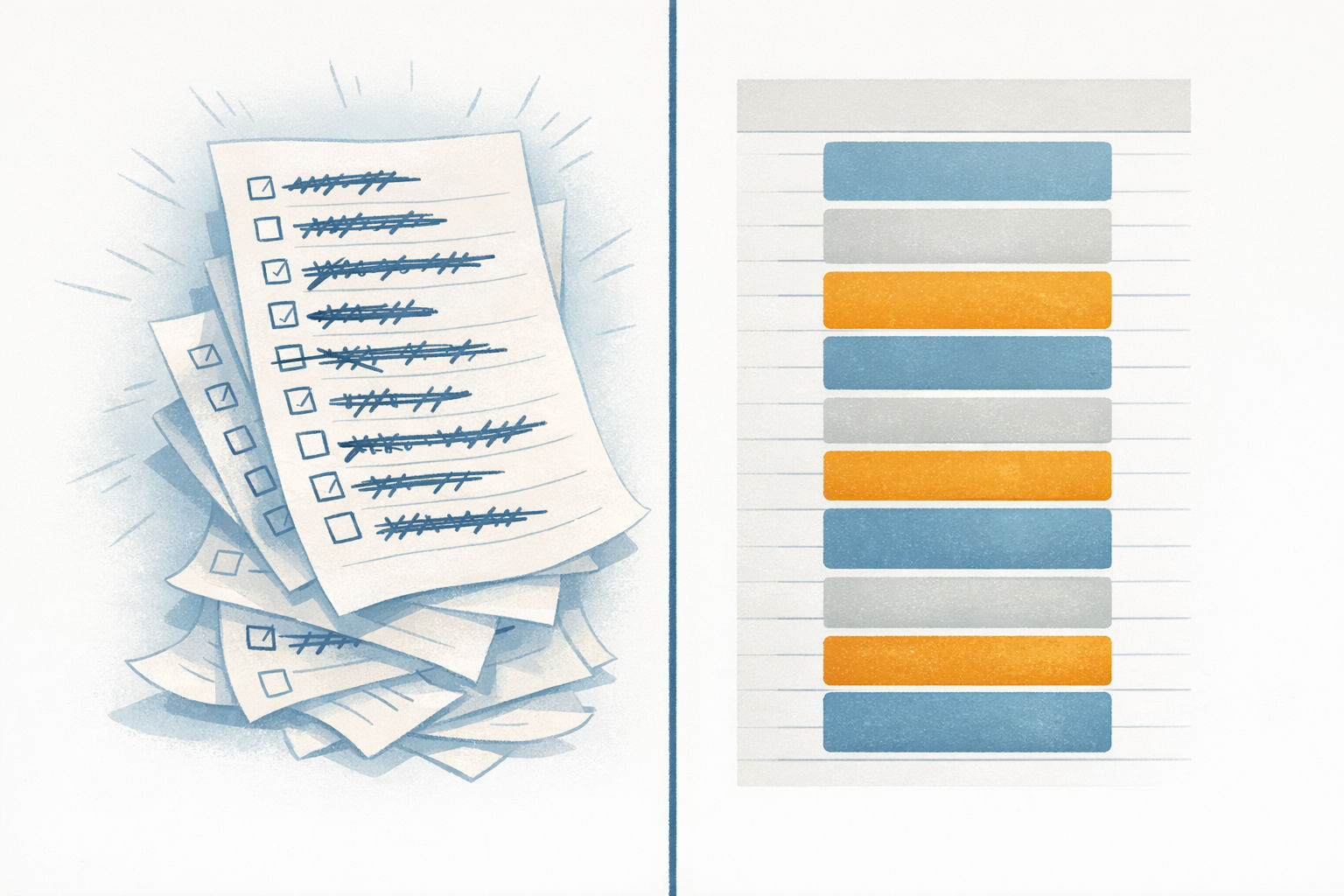
Most knowledge workers run their days from a task list. They capture everything, prioritise ruthlessly, and check items off with satisfying precision. It feels productive. But if you’ve ever reached 5 PM with a dozen items still unchecked — despite being busy all day — you’ve already experienced the core failure mode that cognitive science predicts.
The problem isn’t discipline. It’s architecture. A task list answers what you need to do. It says nothing about when you’ll do it, how long it will take, or what you’ll sacrifice to make room. Time blocking addresses all three — and the research on why it works is more robust than most productivity writing acknowledges.
Here’s an honest look at what the evidence actually says about time blocking versus task lists, where each method breaks down, and how to build a structured day planning system that leverages both. It’s worth noting that the goal of good scheduling isn’t just efficiency — it’s creating the structural conditions for flow state: the neurologically distinct state of deep engagement that Csikszentmihalyi’s research shows produces the highest-quality cognitive output.
The Cognitive Case Against Pure Task Lists
Task lists are popular because they solve a real problem: externalising commitments so your brain doesn’t have to hold them. David Allen’s Getting Things Done system formalised this insight, and it works — as far as it goes.
But task lists have three structural weaknesses that no amount of prioritisation can fix.
Open Loops and the Zeigarnik Effect
In 1927, psychologist Bluma Zeigarnik observed that waiters remembered unpaid orders with near-perfect accuracy — until the bill was settled, at which point the details vanished. Her subsequent experiments confirmed that people recall interrupted tasks roughly 90% better than completed ones.
This isn’t a memory trick. It’s a cognitive burden. Unfinished tasks create what researchers call “open loops” — persistent mental threads that consume working memory. A meta-analysis found that unfinished work tasks are strongly linked to off-job rumination (ρ = .382 between persons), meaning your unchecked to-do list follows you home.
For a deeper exploration of this mechanism, see our piece on the Zeigarnik effect and productivity.
Here’s the critical finding: Masicampo and Baumeister (2011), publishing in the Journal of Personality and Social Psychology, demonstrated that making a specific plan for an unfulfilled goal eliminates its cognitive intrusion — even before you start the work. Participants who wrote down when and where they would complete a task performed just as well on subsequent cognitive tests as those who had already finished it. The open loop closes not when the task is done, but when the brain trusts there’s a plan.
A task list doesn’t provide that closure. It says “write the proposal” without specifying when. The loop stays open. A time-blocked schedule says “write the proposal, Tuesday 9–11 AM” — and the cognitive machinery relaxes.
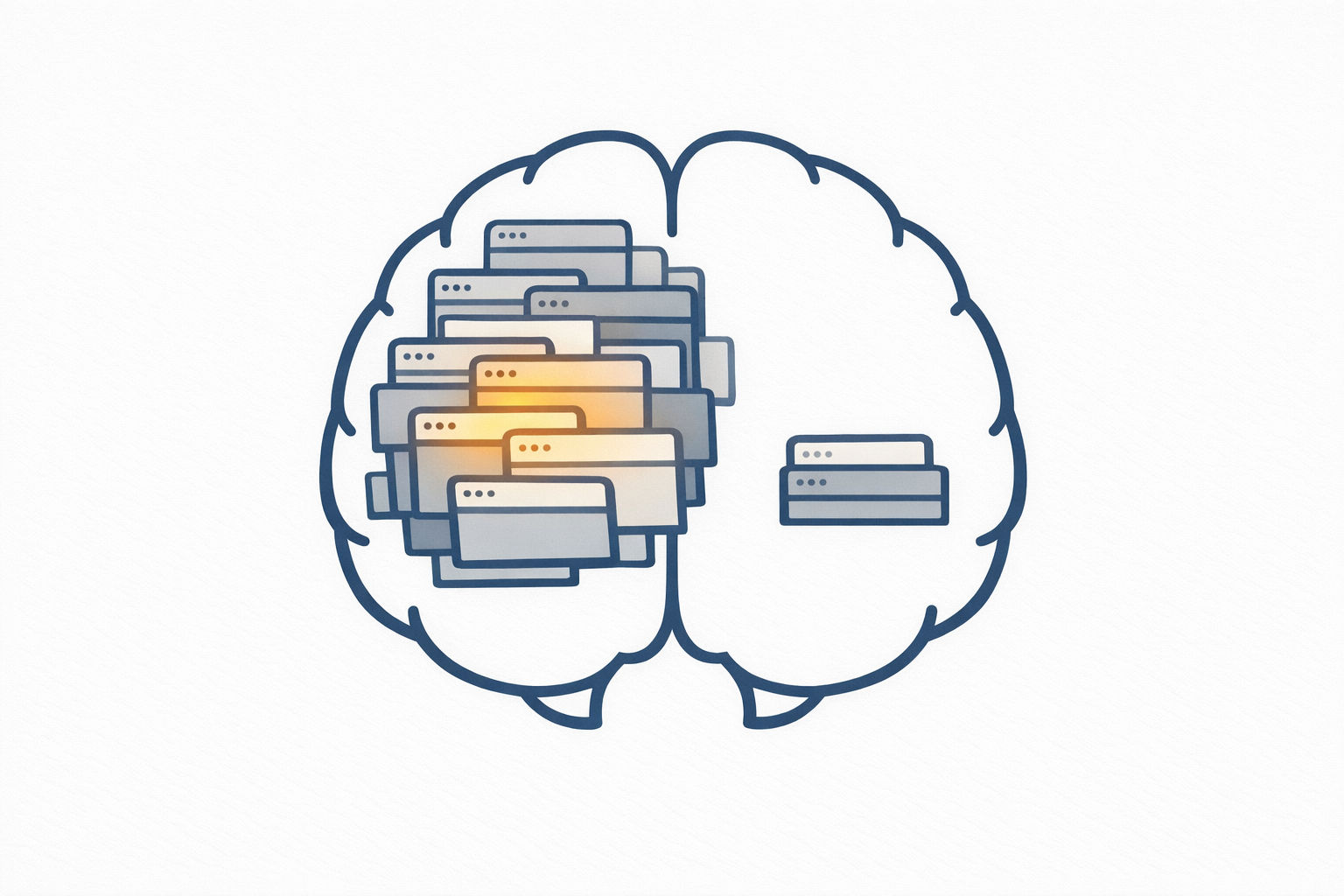
Unfinished tasks act like open browser tabs in your brain — consuming working memory until you either complete them or make a concrete plan.
The Planning Fallacy Compounds Unchecked
Kahneman and Tversky identified the planning fallacy in 1979: people systematically underestimate how long tasks take, even when they’ve failed at the same estimate before. Task lists amplify this bias because they never force a confrontation with finite time.
A list with 15 items says nothing about whether those items fit into your day. You might have four hours of unscheduled time and twelve hours of work. Without time estimates mapped to real calendar slots, you won’t know until it’s too late.
Time blocking surfaces the conflict immediately. When you try to fit eight hours of work into a six-hour day, the schedule pushes back. You’re forced to make trade-offs before the day starts — not at 6 PM when the guilt arrives.
It’s also worth noting that the planning fallacy interacts with procrastination in a specific way: the tendency to underestimate task duration can make difficult work feel more approachable than it is — and when reality hits, the emotional response drives avoidance. The procrastination research is clear that procrastination is primarily an emotion regulation failure, not a time management failure — which means building a realistic time-blocked schedule is one of the strongest structural interventions available, because it removes the anxiety-inducing ambiguity that triggers avoidance in the first place.
No Protection Against Context Switching
Gloria Mark’s observational research at UC Irvine found that knowledge workers take an average of 23 minutes and 15 seconds to fully refocus on a task after an interruption. Sophie Leroy’s 2009 research in Organizational Behavior and Human Decision Processes identified the mechanism: “attention residue.” When you switch from Task A to Task B, part of your cognition remains stuck on Task A — especially if A was unfinished or under time pressure.
A task list provides no structural defence against this. You can work on anything, in any order, at any time. The flexibility that makes lists easy also makes them dangerous for attention residue.
Time blocking creates temporal boundaries. When the block says “deep work on API refactor, 9–11 AM,” you have both permission and obligation to ignore everything else. Leroy’s 2018 follow-up with Glomb in Organization Science found that a “ready-to-resume” plan — essentially, notes on where to pick up an interrupted task — significantly reduces attention residue. Time blocking, by specifying what comes next, provides this by default.
What the Research Hasn't Tested Directly
An important caveat: no published randomised controlled trial has directly compared "time blocking" to "task lists" as complete productivity systems. The phrase "time blocking" doesn't appear in PubMed. The evidence comes from converging research on the underlying mechanisms — implementation intentions, attention residue, and planning behaviour — all of which favour scheduled, time-specific plans over open-ended lists.
Implementation Intentions: The Mechanism Behind Time Blocking
The strongest research foundation for time blocking comes from Peter Gollwitzer’s work on implementation intentions, first formalised in a 1999 paper in American Psychologist.
An implementation intention is a specific plan in the format: “When situation X arises, I will perform behaviour Y.” It differs from a goal intention (“I want to finish the report”) by specifying the when, where, and how of action.
The effect sizes are substantial. In Gollwitzer’s experiments, 80% of participants who formed implementation intentions completed difficult tasks, compared to 25–33% who relied on goal intentions alone. A later meta-analysis by Gollwitzer and Sheeran (2006) across multiple domains reported a medium-to-large effect size (d = 0.61) for implementation intentions on goal striving.
Perhaps the most striking demonstration came from Milne, Orbell, and Sheeran (2002), published in the British Journal of Health Psychology. Participants were asked to exercise at least once in the following week. Among those who simply formed the intention, 34% exercised. Among those who also wrote down exactly when and where they would exercise — an implementation intention — 91% followed through.
For a comprehensive look at this research, see implementation intentions and how if-then planning doubles follow-through rates.
Time blocking is, in effect, a systematic way to create implementation intentions at scale. When you write “9:00–10:30 — draft Q3 roadmap in the quiet office” into your schedule, you’ve specified the when, the what, and the where. Your brain treats this differently from an unconstrained list item. As Gollwitzer described it, implementation intentions “delegate the control of goal-directed responses to anticipated situational cues” — which means they reduce the cognitive effort required to start.
This is why time blocking works not because it makes you busier, but because it removes the decision overhead that otherwise sits between you and the work.
What Task Lists Actually Get Right
None of this means task lists are useless. They solve problems that pure time blocking doesn’t.
Low-friction capture. When a thought or commitment surfaces — in a meeting, on a walk, at 2 AM — you need a place to put it immediately. A task list’s value is in collection, not execution. Trying to find the right calendar slot in the moment interrupts the flow of whatever you’re doing.
Flexible prioritisation. Lists let you re-order, tag, group, and filter tasks by project, context, or energy level. A time-blocked calendar is optimised for a specific day; a task list is a living inventory across all days.
Adaptability to chaos. In roles with high interrupt rates — support engineers, managers with open-door policies, on-call developers — a rigid time-blocked schedule can shatter by 10 AM. Task lists degrade more gracefully because they don’t encode specific time commitments.
The research supports this nuance. A 2021 meta-analysis by Aeon, Faber, and Panaccio in PLoS ONE, covering 53,957 participants, found that time management is moderately related to job performance — but its strongest relationship is with wellbeing and life satisfaction, not raw output. The system you choose matters as much for how you feel as for what you produce. Forcing a rigid time-blocking schedule on someone in a highly reactive role may increase stress, not reduce it.
Your environmental design also plays a role here that most scheduling discussions overlook. The research on choice architecture shows that your workspace makes hundreds of decisions for you daily — which apps are visible, which notifications fire, which defaults pull your attention. Even the best time-blocked schedule degrades when your digital environment is designed to interrupt it. Structuring your physical and digital context to reduce friction for the right tasks is the complement to structuring your calendar.
Time Blocking vs. Task Lists: Where Each Method Wins
| Dimension | Task Lists | Time Blocking |
|---|
| Task capture | Excellent — low friction, instant | Poor — requires finding a slot |
| Specifying *when* | Absent — no time commitment | Core strength — every task is scheduled |
| Cognitive load | High — constant reprioritisation | Low — decisions made in advance |
| Zeigarnik closure | Weak — open loops persist | Strong — plan satisfies the loop |
| Planning fallacy protection | None — no time awareness | High — schedule exposes overcommitment |
| Flexibility | High — reorder anytime | Moderate — rescheduling takes effort |
| Interrupt handling | Degrades gracefully | Can shatter without buffers |
| Deep work protection | None — no temporal boundaries | Strong — blocks create boundaries |
How to Design a Time-Blocked Day That Doesn’t Shatter
The evidence points clearly toward a hybrid: use task lists for capture and prioritisation, use a time-blocking schedule for execution. Here’s how to implement this without the rigidity that causes most people to abandon time blocking within a week.
Cal Newport, the Georgetown computer scientist who popularised time blocking in Deep Work (2016), emphasises that the value comes from intentionality, not rigid adherence. “You can revise blocks as the day unfolds,” he writes. The schedule is a hypothesis about how to spend your time — not a contract.
Building a Time-Blocked Day: A Research-Backed Process
Step 1
Capture everything into a single task list
Don't abandon your task list — it's your inventory. Every task, idea, and commitment goes into one place. This is where GTD's capture principle remains valuable. The list answers *what* needs doing.
Step 2
Add time estimates before you schedule
This is the step most people skip, and it's where the planning fallacy lives. Before assigning tasks to blocks, estimate duration. Pad generously — research consistently shows we underestimate by 25–50%. A 60-minute task should get a 75–90 minute block.
Step 3
Block your non-negotiables first
Meetings, recurring commitments, and biological needs (lunch, breaks) go in first. These are constraints, not tasks. What remains is your actual available work time — typically less than you think.
Step 4
Schedule deep work during your peak cognitive hours
Match your highest-demand tasks to your biological peak. For most people, this is 2–4 hours in the morning. Protect these blocks ruthlessly. For the science behind this, see our guide to scheduling tasks by cognitive load.
Step 5
Leave 20–30% of your day unscheduled as buffer
Buffer blocks are not laziness — they're engineering. They absorb overruns, handle interruptions, and prevent a single delay from cascading through every remaining block. Without buffers, time blocking becomes brittle.
Step 6
Review and revise at midday
Newport's method includes a midday checkpoint: look at what's left, reassess priorities, and re-block the afternoon. The morning plan rarely survives intact, and that's fine. The point is continuous intentionality, not perfect prediction.
This is where a tool built for time blocking — rather than one adapted from a calendar or to-do app — makes a meaningful difference. Daybook’s daily planning view lets you lay out scheduled time blocks alongside your task list in a single plain-text interface, so the capture-to-schedule loop takes seconds rather than minutes. Because it’s keyboard-first, restructuring your day midstream doesn’t break your flow.
For a deeper guide on building resilient schedules, see how to build a time-blocked schedule that survives contact with reality. And if you want to go a level further with scheduling precision, our comparison of timeboxing versus time blocking explains how adding a hard time constraint to your blocks activates Parkinson’s Law in your favour — a meaningfully different technique that the research treats as distinct from standard time blocking.
Once your schedule creates genuine stretches of protected focus time, the research on task batching answers the next question: which tasks actually belong together in those blocks, and how do you group shallow work so it doesn’t contaminate your deep work windows.
The Rigidity Trap
The most common reason people abandon time blocking is over-scheduling: packing every minute with tasks and leaving no margin for reality. If your time-blocked day has zero buffer, it will fail on first contact with an unexpected Slack message or a meeting that runs over. The research on cognitive load and scheduling supports capping planned deep work at roughly four hours per day — the same limit Ericsson found for deliberate practice in elite performers.
The Verdict: Neither System Alone, But Not Equal Either
The research doesn’t support the claim that time blocking is universally superior. People in highly reactive roles, or with severe schedule unpredictability, may find pure time blocking counterproductive. Task lists remain the best tool for capture and flexible prioritisation.
But the cognitive science is clear on one point: specifying when you’ll do something dramatically increases the probability that you’ll do it. Implementation intentions produce medium-to-large effect sizes across dozens of studies. The Zeigarnik effect means unplanned tasks tax your working memory all day. Attention residue means every unscheduled context switch degrades performance for the next 23 minutes.
Task lists tell you what to do. Time blocking tells you when. The evidence consistently favours the system that answers both questions.
The practical answer isn’t to choose between them. It’s to use your task list as the source of truth for what needs doing, and your time-blocking schedule as the execution layer that turns intentions into committed slots. The research on implementation intentions, the Zeigarnik effect, and attention residue all converge on the same structural insight: your brain works better when it knows not just what’s next, but exactly when it will happen.
Plan Your Day With Scheduled Time Blocks
Daybook combines a task list with a time-blocking schedule in a single keyboard-first interface. Capture tasks, block your day, and adjust on the fly — all in plain text.
Try Daybook Free