The Pomodoro Technique at 35 Years: What the Research Says About Interval Work and Whether It Actually Holds Up
The Pomodoro Technique's 25-minute interval was never derived from a lab study. Here's what the actual cognitive science says about structured work-rest cycling — and a practical framework for choosing the right interval length for your work.
Francesco Cirillo didn’t start with pomodoro technique research. He started with a kitchen timer.
In the late 1980s, Cirillo was a struggling university student at Luiss Business School in Rome. He couldn’t focus. His solution wasn’t drawn from cognitive science journals — it was a tomato-shaped timer he borrowed from his mother’s kitchen. He bet himself he could sustain genuine concentration for just ten minutes.
That bet became the Pomodoro Technique: 25 minutes of focused work, 5-minute break, repeat four times, then take a longer break. It’s now one of the most widely practiced productivity methods in the world, with thousands of dedicated apps and millions of practitioners.
But here’s the part that rarely gets mentioned: the 25-minute interval was never validated in a lab. It emerged from Cirillo’s personal experimentation — iterating upward from his initial 10-minute challenge until he landed on a duration that felt right. The scientific basis was largely retrofitted after the technique gained popularity.
That doesn’t mean the Pomodoro Technique is wrong. But 35 years on, we have enough research to ask a sharper question: does the science of interval work actually support a fixed 25-minute cycle? And if not, what does it support?
The Science Pomodoro Claims — and Where It Breaks Down
Advocates of the Pomodoro Technique often cite ultradian rhythms as its scientific foundation. The logic goes: our brains naturally cycle between periods of alertness and rest, so working in structured intervals aligns with biology.
This is half right — and the half that’s wrong matters.
Nathaniel Kleitman, the researcher who co-discovered REM sleep, proposed the Basic Rest-Activity Cycle (BRAC) in the early 1960s. His hypothesis was that the 90-minute sleep cycle doesn’t simply stop when we wake up — it continues throughout the day as an oscillation between higher and lower alertness. Peretz Lavie at the Technion Institute later validated this with rigorous laboratory studies, measuring reaction times, arithmetic performance, and sustained attention in subjects who were unaware of the 90-minute hypothesis.
Lavie documented an “ultradian 75- to 125-minute rhythm in alertness” — each cycle comprising roughly 80–90 minutes of heightened focus followed by approximately 20 minutes of naturally diminished energy. EEG studies confirmed this with notable precision: during trough periods, brain-wave activity shifts toward slower theta-dominant patterns, heart rate decreases, and hormonal markers including cortisol exhibit ultradian pulsatility.
The problem for Pomodoro? 25 minutes doesn’t map onto these cycles. The ultradian research suggests your brain’s natural focus unit is roughly 80–90 minutes — not 25. A Pomodoro interrupts you roughly one-third of the way through your brain’s natural alertness peak. Four consecutive Pomodoros (about two hours including breaks) come closer to one full ultradian cycle, but the breaks fragment what could be continuous deep focus.
The Ultradian Mismatch
Kleitman and Lavie's research suggests a natural focus cycle of 80–120 minutes, not 25. Four Pomodoro cycles approximate one ultradian cycle — but the three intermediate breaks fragment what the biology suggests could be sustained focus. For a deeper look at this research, see our full analysis of ultradian rhythms and the 90-minute work cycle.
The Research That Does Support Structured Breaks
Dismissing Pomodoro entirely would be its own kind of error. The technique gets one thing fundamentally right: sustained attention on a single task degrades over time, and structured breaks can prevent it.
This was first demonstrated by Norman Mackworth in 1948, well before Cirillo picked up his kitchen timer. Mackworth’s clock test — designed for British Air Force radar operators — showed that detection accuracy drops significantly after roughly 30 minutes on a monotonous vigilance task. The performance decline was steady through the first 90 minutes, with partial recovery that never returned to baseline.
More directly relevant is the 2011 study by Atsunori Ariga and Alejandro Lleras at the University of Illinois. They had 84 participants perform a 50-minute repetitive visual task, divided into four groups with different break conditions. The results were striking: the group that took brief mental switches (just two to three interruptions over 50 minutes) showed no performance decline, while all other groups — including one that was exposed to the same stimuli but didn’t actively switch tasks — degraded significantly.
Constant stimulation is registered by our brains as unimportant, to the point that the brain erases it from our awareness. This study is consistent with the idea that the brain is built to detect and respond to change, and suggests that prolonged attention to a single task actually hinders performance.
Lleras’s explanation is important: the decline isn’t about running out of “attention fuel.” It’s about goal habituation — your brain deprioritizes unchanging stimuli, the same way you stop noticing the feel of clothing on your skin. Brief diversions reactivate the goal, preventing the habituation.
This supports the principle behind Pomodoro — structured breaks maintain attention — but not the specific timing. Lleras’s subjects needed only two to three brief switches across 50 minutes, not a break every 25.
Then there’s the DeskTime data. In 2014, the time-tracking company analyzed their top 10% most productive users and found they worked in 52-minute sprints with 17-minute breaks. But when they repeated the study in 2025, the ratio had shifted to 75 minutes of work followed by 33-minute breaks. The “optimal” ratio keeps changing because it was never a biological constant — it reflects the work patterns of a specific population at a specific time.
What the RCTs Actually Show
The most rigorous test of the Pomodoro Technique to date is Biwer et al. (2023), published in the British Journal of Educational Psychology. Eighty-seven university students were randomly assigned to three conditions: Pomodoro breaks (6 minutes after every 24-minute block), systematic-short breaks (3 minutes after every 12-minute block), or self-regulated breaks.
The headline finding: no significant difference in productivity, task completion, or flow between any of the groups.
The nuances matter, though. Students who self-regulated their breaks reported higher fatigue and distractedness. The Pomodoro group maintained better mood and concentration — they just didn’t produce more. A 2025 replication with 94 students found the same pattern: Pomodoro breaks led to faster increases in fatigue and faster decreases in motivation, but no differences in actual output.
A 2025 scoping review in BMC Medical Education aggregated 32 studies (N = 5,270) examining structured Pomodoro-style intervals. Across three RCTs, structured intervals produced approximately 20% lower fatigue and modest improvements in self-rated focus compared to self-paced schedules. But 88% of the studies showed positive outcomes partially because most were observational — they measured how people felt about the technique, not whether it objectively improved output.
The pattern in the literature is consistent: structured intervals improve the subjective experience of work more than the objective output. That’s not nothing — reduced fatigue and better mood matter — but it’s a more modest claim than “the Pomodoro Technique makes you more productive.”
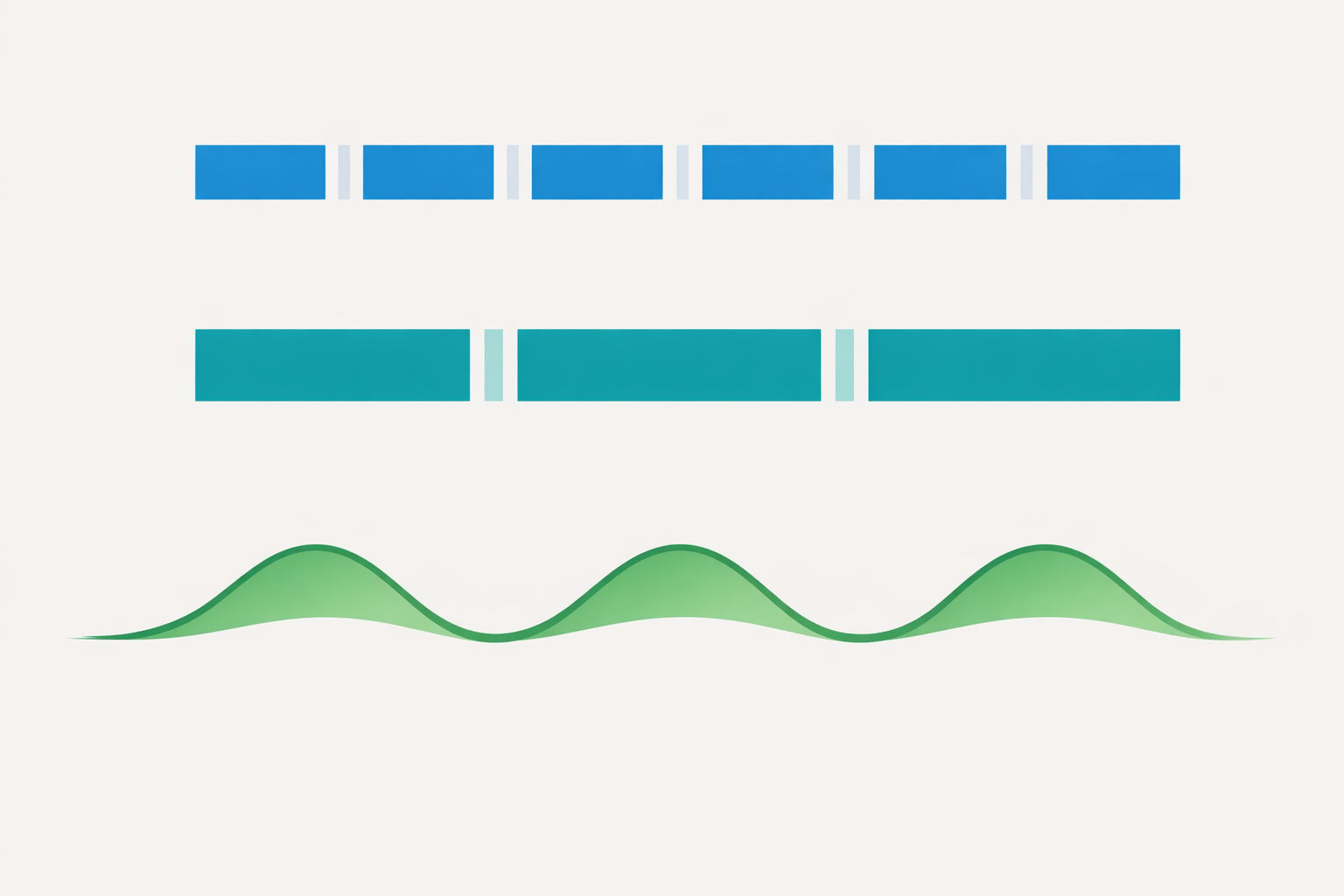
Work-rest intervals come in many ratios — the research suggests no single split is universally optimal.
Where Pomodoro Actually Works — and Where It Doesn’t
The evidence paints a clear picture: the Pomodoro Technique isn’t a universal productivity law. It’s a scaffold — and like all scaffolds, it’s most useful when you’re building something you haven’t built before.
It works well for:
Beginners building focus tolerance. If you currently can’t sustain 25 minutes of undistracted work, Pomodoro gives you a concrete, achievable target. The timer externalizes discipline, which matters when your focus muscle is weak.
Tasks requiring rhythmic output. Writing, coding feature implementations, processing email, data entry — work where the unit of progress is relatively small and you benefit from regular momentum resets.
Procrastination-prone tasks. The “just 25 minutes” framing lowers the activation energy for starting. A 2020 study of 12 participants found all reported that the technique helped manage multitasking tendencies — a small sample, but consistent with the procrastination-reduction literature.
It works poorly for:
Extended deep work. Architecture design, complex system debugging, mathematical proofs, strategic analysis — work where you need to load a large mental model into working memory and hold it there. Gloria Mark’s research at UC Irvine shows it takes an average of 23 minutes and 15 seconds to fully recover from an interruption. A Pomodoro break after 25 minutes could destroy the very state you just spent 23 minutes building.
Flow-dependent creative work. Mihaly Csikszentmihalyi’s research on flow states suggests that deep absorption requires an uninterrupted progression through challenge-skill balance. A timer ringing during flow is the definition of a counterproductive interruption.
Experienced deep workers. If you can already sustain 60–90 minutes of concentrated effort, Pomodoro’s 25-minute ceiling is actively limiting. Cal Newport, who initially recommended 50-minute study blocks, later shifted to scheduling 4–7 consecutive hours of deep work, noting that “few can maintain peak cognitive intensity for more than an hour or so” — but that with careful “deep breaks,” much longer sessions are possible.
The Pomodoro Technique: Evidence-Based Assessment
Pomodoro Technique (25/5)
Externalizes discipline for beginners — lowers the barrier to starting
Structured breaks reduce subjective fatigue by ~20% (2025 scoping review)
Simple enough to start immediately with zero setup
Effective for rhythmic, small-unit tasks (writing sprints, coding features)
Helps chronic procrastinators by making tasks feel finite
Pomodoro Technique (25/5)
25-minute interval has no basis in ultradian rhythm research (80-120 min cycles)
RCTs show no objective productivity advantage over self-regulated breaks
Interrupts deep work before working memory can fully load complex mental models
Can increase fatigue and decrease motivation faster than self-paced work (Biwer et al., 2023)
A Practical Framework: Match Interval Length to Cognitive Load
The research points to a better approach than any fixed interval: match your work-rest cycle to the cognitive demands of the task. This is closer to what the science of timeboxing actually supports — constrained effort adapted to context, not a one-size-fits-all timer.
Here’s a framework grounded in the evidence:
Interval length framework based on cognitive load and task type
Task Type
Suggested Interval
Break Length
Rationale
Low cognitive load (email, admin, data entry)
25 min
5 min
Classic Pomodoro works here. Tasks are small-unit and benefit from rhythmic pacing.
Medium load (writing first drafts, routine coding, review)
45–50 min
10 min
Aligns with Mackworth's ~30-min vigilance threshold. Long enough for meaningful progress without hitting steep decline.
High load (system design, complex debugging, strategic analysis)
75–90 min
15–20 min
Matches ultradian rhythm research (Kleitman, Lavie). Allows full loading of complex mental models into working memory.
Flow-dependent creative work
Until natural break point
15–30 min
Don't interrupt flow. Use a timer as a check-in reminder, not a hard stop. Self-regulated breaks perform equally well in RCTs.
How to Apply This in Practice
Before starting a work block, categorize the task by cognitive load. Set your timer accordingly — 25 minutes for admin batching, 50 minutes for writing, 90 minutes for deep technical work. In Daybook, you can schedule tasks by cognitive load by placing high-load work during your biological peak and low-load tasks in natural troughs. The key isn't the timer — it's the deliberate match between interval and demand.
The Verdict: Scaffold, Not Law
The Pomodoro Technique is 35 years old, and the honest assessment is this: it’s a useful training tool that was popularized faster than it was validated.
The 25-minute interval was born from a kitchen timer and personal experimentation — not from Kleitman’s ultradian cycles, not from Lleras’s attention research, not from any controlled study. The science that does support structured work-rest patterns supports the principle of deliberate breaks, not the specific ratio of 25/5.
The RCT evidence is modest at best. Structured intervals reduce fatigue and improve mood. They don’t reliably increase output. And for experienced knowledge workers engaged in complex, flow-dependent deep work, a rigid 25-minute timer may actively interfere with performance.
But for a developer who can’t stop checking Slack, a writer staring at a blank page, or anyone trying to build the habit of sustained focus from scratch — the Pomodoro Technique remains a reasonable starting point. The timer externalizes a commitment. The break makes the work feel finite. The ritual reduces the cognitive overhead of deciding when to stop.
Just don’t mistake the scaffold for the building. As your focus capacity grows, let the intervals grow with it. Match the timer to the task, not the task to the timer.
That’s what the research actually says.
Plan Your Day by Cognitive Load, Not Just Time
Daybook's keyboard-first daily planner lets you structure your schedule around how your brain actually works — blocking deep work in your peak hours and batching shallow tasks when energy dips. No rigid timers. Just a plan that matches your biology.