Your calendar is blocked. Your to-do list is prioritized. You’ve read the book on time blocking, you’ve tried Pomodoro, and you dutifully review your week every Sunday night. And yet — you still end most days feeling scattered, reactive, and unsure where the hours actually went.
The problem isn’t your system. It’s your unit of analysis.
Attention management — not time management — addresses the actual bottleneck in knowledge work. This isn’t a productivity hack or a rebranding exercise. It’s a structural reorientation backed by five decades of research, from Herbert Simon’s economics of information to Gloria Mark’s field studies on screen behavior. The evidence is clear: time is not the scarce resource. Attention is.
The Attention Economy Isn’t New — You’re Just Living in It Now
In 1971, Nobel laureate Herbert Simon articulated what would become the foundational insight of modern productivity research:
“A wealth of information creates a poverty of attention and a need to allocate that attention efficiently among the overabundance of information sources that might consume it.”
Simon was writing about organizational design, but the principle scales down to individual knowledge work. Every Slack notification, every email thread, every “quick question” in a meeting is an information source competing for a fixed cognitive budget.
Twenty-six years later, researcher Michael Goldhaber formalized this in his 1997 essay The Attention Economy and the Net, published in First Monday. His argument: in a networked world, attention — not information, not money — becomes the fundamental scarce resource. “What counts most is what is most scarce now, namely attention,” Goldhaber wrote. The essay reads less like prediction today and more like a diagnosis.
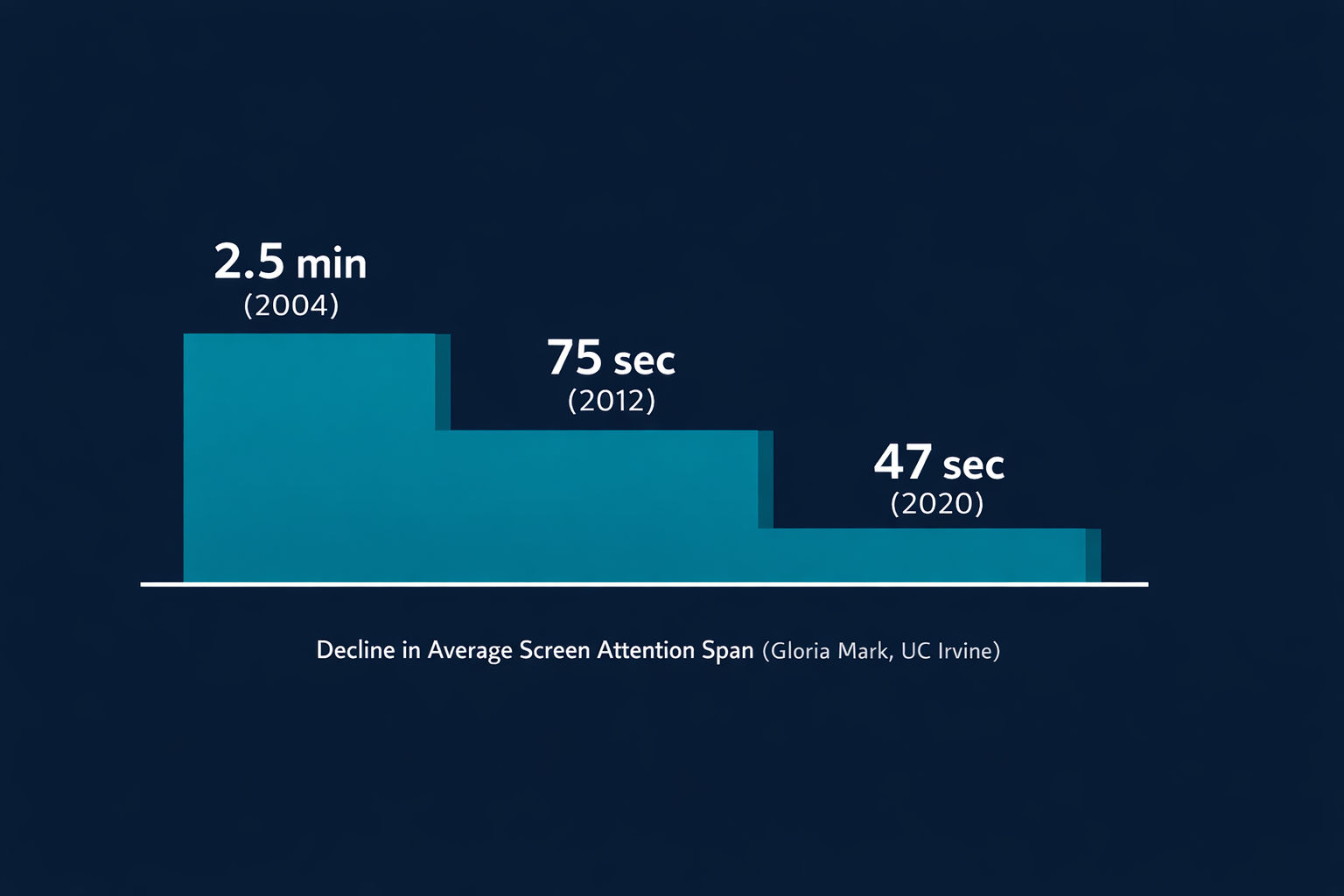
The diagnosis has gotten worse. Gloria Mark, Chancellor’s Professor of Informatics at UC Irvine, has tracked attention spans on screens for over two decades. Her longitudinal data tells a stark story:
Average time on a single screen before switching, per Gloria Mark's UC Irvine studies (2004–2020)
In 2004, the average person focused on a single screen for 2.5 minutes before switching. By 2012, that dropped to 75 seconds. By 2020, it had settled at 47 seconds — with a median of just 40. As Mark details in her 2023 book Attention Span, this isn’t a failure of willpower. It’s a structural condition of working in environments designed to fragment your focus.
Here’s what this means concretely: if you’re a developer, consultant, or founder whose output depends on sustained cognitive effort, you’re operating in an environment that interrupts your deepest work roughly every 47 seconds. No calendar grid can fix that.
Why a Full Calendar Doesn’t Mean Productive Output
Time management assumes a linear relationship between hours invested and work produced. For industrial work, that’s roughly true — an assembly line worker’s output scales with hours on the line. But knowledge work operates on a fundamentally different equation, one that Cal Newport has articulated as:
High-Quality Work Produced = Time Spent × Intensity of Focus
This changes everything. An hour of fragmented, notification-interrupted writing produces measurably less than 30 minutes of deep, unbroken concentration. The multiplier isn’t time — it’s attentional intensity.
The research supports this. A 2021 meta-analysis by Aeon et al., published in PLoS ONE, examined 158 studies (N > 33,000) on time management effectiveness. The correlation between time management and job performance? A moderate r = .25. Time management helps — but not nearly as much as the industry of planners, apps, and seminars would suggest.
Meanwhile, Draheim et al. (2023), publishing in Psychonomic Bulletin & Review, found that sustained-attention capacity predicts workplace performance better than working memory or IQ. The bottleneck isn’t how you schedule your hours. It’s whether you can sustain focus during them.
This is why the 4-day workweek data is so instructive. In the UK’s landmark pilot program, 54 of 61 participating companies maintained the policy permanently after seeing 25–40% productivity increases — with fewer hours worked. Employees reported 67% lower burnout. The explanation isn’t mysterious: fewer hours forced better attention allocation. People stopped filling time and started protecting focus.
The Core Distinction
Time management asks: How do I fit more into my schedule?
Attention management asks: How do I protect my cognitive capacity for the work that actually matters?
One optimizes the container. The other optimizes what goes into it.
The Three Layers of Attention Management
Attention management isn’t a single technique. It operates on three distinct layers, each addressing a different source of focus degradation. Skip any one of them and the others compensate poorly.
Layer 1: Internal Distraction — Mind-Wandering and Attention Residue
The most underestimated threat to focus isn’t your phone. It’s your own mind.
Sophie Leroy’s foundational 2009 research on attention residue — published in Organizational Behavior and Human Decision Processes — demonstrated that switching tasks leaves cognitive traces of the previous task lingering in working memory. These traces measurably impair performance: slower recall, missed details, lower decision quality. Critically, Leroy found that simply finishing a task isn’t enough to clear the residue. The brain needs a deliberate transition — what she calls a “ready-to-resume plan” — to fully disengage.
For knowledge workers, the implication is direct. Every time you check Slack between deep work blocks, you’re not just losing the 30 seconds it takes to glance at a message. You’re importing attention residue that degrades your next 10–15 minutes of cognitive performance. If you’re interested in how this connects to structuring your work blocks, we’ve written about the research on task batching and attention residue.
Nir Eyal’s Indistractable framework adds an important nuance here. Eyal argues that “distraction starts from within” — that most device-checking behavior is triggered not by notifications but by uncomfortable internal states like boredom, anxiety, or uncertainty. “The opposite of distraction is not focus,” Eyal writes. “It is traction. Traction and distraction are actions — things we do, not things that happen to us.” Managing internal distraction means learning to notice the emotional trigger before the habitual response.
Layer 2: External Distraction — Environment Design and Notification Management
Gloria Mark’s research shows that self-interruptions now match external interruptions in frequency. But external triggers still matter enormously — because they train the self-interruption habit.
The data from MIT’s Attention Lab (2024) quantifies the cost: continuous partial attention — the state of monitoring multiple channels simultaneously — raises error rates by 37% and cuts working memory accuracy by 20%. Stanford’s Communication Lab (2022) found that heavy multitaskers performed worse on attention-control tests than sequential workers, even when tested on single tasks. The damage isn’t just situational; it’s cumulative.
Environment design is Layer 2 of attention management: reducing the external triggers that fragment focus before they reach you. This means notification audits, communication norms (Atlassian’s 2024 pilot of asynchronous communication protocols increased project milestones by 22%), and workspace design that defaults to focus rather than availability.
This is also where your tools matter. A planning interface that demands constant clicking, scrolling, and context-switching between views is itself an external distraction. Daybook’s keyboard-first design exists precisely because of this principle — keeping your hands on the keyboard and your eyes on your plan eliminates the micro-interruptions that accumulate across a day of planning and replanning.
Layer 3: Strategic Scheduling — Aligning Cognitive Demand with Biological Capacity
The third layer is the bridge between attention management and time management: scheduling your most cognitively demanding work during your biological peak windows.
Research on chronotype synchrony (Blume et al., 2023, PMC) shows that aligning high-cognitive-load tasks with your natural energy peaks produces 20–35% performance gains in attention, processing speed, and decision quality. Morning chronotypes show peak executive function between roughly 7–10 AM; evening types perform best in the afternoon and evening. The effect is real and measurable — yet most people schedule their deep work reactively, slotting it wherever meetings leave a gap.
This connects directly to the research on ultradian rhythms and the 90-minute work cycle. Your brain’s capacity for sustained focus isn’t flat across the day — it oscillates in roughly 90-minute cycles. Elite performers across domains (musicians, chess grandmasters, mathematicians) sustain a maximum of about 4 hours of deep work daily. That’s not a productivity failure. It’s a biological constraint.
Strategic scheduling means accepting this constraint and designing around it: placing your highest-leverage cognitive work in your peak 2–4 hour window and ruthlessly protecting it. Everything else — email, meetings, administrative tasks — gets scheduled around the edges, not through the middle.
Time Management vs. Attention Management: A Structural Comparison
| Dimension | Time Management | Attention Management |
|---|
| Core question | How do I use my hours efficiently? | How do I protect my cognitive capacity? |
| Unit of analysis | Clock time (hours, minutes) | Attentional capacity (depth, quality) |
| Primary tool | Calendar, schedule, planner | Environment design, energy mapping, distraction protocols |
| Assumes | Output scales linearly with hours | Output = Time × Intensity of Focus |
| Failure mode | Overcommitted but productive | Busy but scattered and reactive |
| Research correlation with job performance | Moderate (r = .25, Aeon et al. 2021) | Strong (sustained attention predicts better than IQ, Draheim et al. 2023) |
How to Audit Your Attention (Not Just Your Time)
Most productivity advice starts with a time audit: track how you spend your hours for a week. That’s useful, but incomplete. An attention audit tracks something different — the quality of your focus during those hours.
Here’s a concrete 2-day protocol:
The 2-Day Attention Audit
Step 1
Set up a simple log
Use a plain text file, a notebook, or a single note in Daybook. Create two columns: **Activity** and **Attention State**. For attention state, use three labels: **Deep** (fully absorbed, no switching), **Shallow** (task-focused but interruptible), or **Fragmented** (switching between tasks or reacting to inputs). Set a timer to prompt you every 30 minutes.
Step 2
Log for two full work days
Every 30 minutes, record what you're doing and your honest attention state. Don't optimize — just observe. Note when you self-interrupt (checking Slack unprompted, opening a browser tab reflexively) vs. when you're externally interrupted. Also note your subjective energy level: High, Medium, or Low.
Step 3
Calculate your attention ratios
After two days, tally the percentage of 30-minute blocks spent in each state. Most knowledge workers discover that Deep blocks account for less than 20% of their workday, even when their calendar shows 6+ hours of 'work time.' The gap between scheduled time and attentional quality is your attention deficit.
Step 4
Map your energy peaks
Overlay your attention state and energy level data. Look for the 2–3 hour window where Deep + High Energy co-occur most naturally. This is your biological prime time for cognitively demanding work. If you're currently scheduling meetings or admin during this window, you've found your highest-leverage change.
Step 5
Redesign one week around the findings
Use the audit data to restructure a single test week. Protect your peak window for deep work. Batch shallow tasks into low-energy periods. Eliminate or reduce one source of fragmentation you identified (a recurring notification, an unnecessary check-in, a reflexive tab). Measure subjective output quality at the end of the week.
The attention audit often reveals a pattern that no time audit can: you have enough hours, but your attention is allocated backwards. Your deep work lands in your worst cognitive windows, your peak energy gets consumed by meetings, and your “free time” is already fragmented before you sit down to use it.
If you use time blocking or timeboxing already, the audit tells you what to put in each block — and more importantly, what to protect each block from. The blocks themselves are just containers. Attention management determines whether those containers hold focused output or scattered busywork.
This Isn’t a Hack — It’s a Different Measurement
The shift from time management to attention management isn’t about adding another layer to your productivity stack. It’s about changing what you measure.
Time management measures input: hours allocated, tasks scheduled, deadlines met. Attention management measures capacity: depth achieved, focus sustained, cognitive energy preserved. The first tells you whether you were busy. The second tells you whether you did the work that mattered.
As the research on time blocking vs. task lists shows, the most effective systems don’t just organize your tasks — they create the conditions for sustained attention through implementation intentions and reduced decision fatigue.
Herbert Simon warned in 1971 that information systems should “listen and think more than they speak.” The same principle applies to your personal productivity system. The best planning tools don’t add noise to your day — they reduce it. They give you a clear view of what matters, then get out of the way so you can actually focus on it.
That’s the real test of any system you use to plan your day. Not whether it helps you schedule more, but whether it helps you focus better. The hours were never the problem.
Plan your day without losing your focus
Daybook is a keyboard-first daily planner built for knowledge workers who need to protect their attention, not just organize their time. Plain text. No clutter. No clicking through menus.
Try Daybook free